

EV concepts
EV Charge Points (EV CP)
An EV charge point, also referred to as a charging station, is infrastructure that supplies electrical energy for recharging plug-in electric vehicles. EV charge points can support different vehicle categories, charging standards, and power levels, ranging from low-power AC charging to high-power DC charging.
The EV Charge Point data model is based on the Open Charge Point Interface (OCPI). It follows OCPI concepts and object relationships to enable interoperability between Charge Point Operators (CPOs) and eMobility Service Providers (eMSPs).
In addition to the OCPI core model, the data includes custom attributes that enrich the standard objects with additional location context, eMSP and roaming information, contact details, and selected capabilities such as support for heavy vehicles. These extensions are designed to complement OCPI without altering its core semantics.
Structure of EV Charge Point data
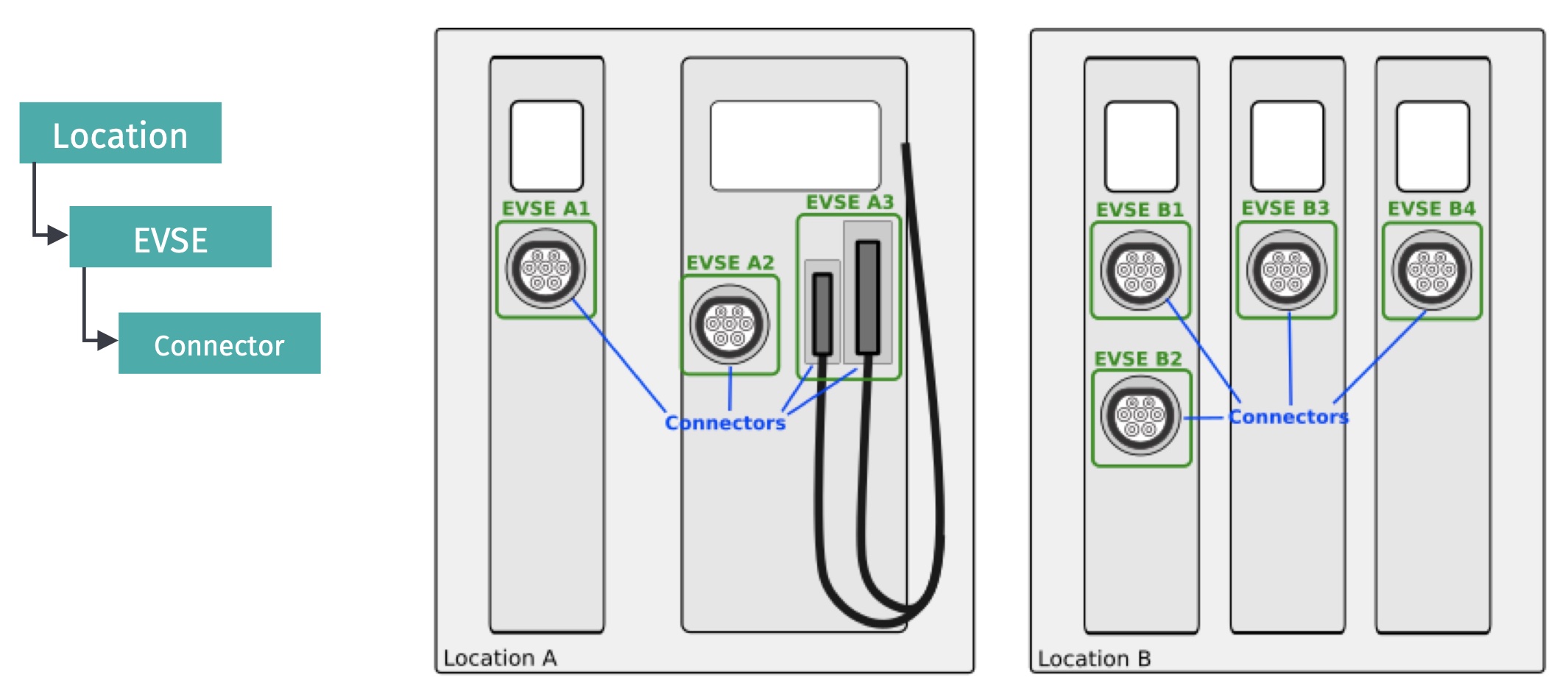
EV Charge Point data is structured into three hierarchical levels: Location, Electric Vehicle Supply Equipment (EVSE), and Connector. An additional grouping concept, Connector Group, is used to model shared electrical or logical constraints across connectors.
The following figure shows the EV charging data hierarchy from Location to EVSE to Connector.
Location
In line with OCPI, a Location describes the physical place where a group of EVSEs that belong together are installed. A Location contains precise geographic information and identifies the parties involved in operating the charging infrastructure.
Each Location always contains at least one EVSE. Custom attributes may be used to enrich the Location with additional site-level information, such as access conditions, parking characteristics, or vehicle constraints that are relevant for routing and discovery use cases.
Locations are sometimes referred to as pools, particularly in the context of the eMI3 protocol.
EVSE
An EVSE represents the part of the charging infrastructure that controls power delivery to a single electric vehicle during one charging session. An EVSE always belongs to a Location and always contains at least one Connector.
As defined by OCPI, dynamic availability and operational status are reported at the EVSE level. EVSE is sometimes referred to as a station, charge point, or stall.
Custom attributes may extend the EVSE with additional capabilities or classifications, for example to indicate accepted payment methods.
Connector
A Connector represents the physical socket or cable and plug that is used by an electric vehicle to charge. A Connector always belongs to an EVSE.
Connector data describes the technical charging interface, including the connector standard and electrical characteristics. While an EVSE may expose multiple connectors, only one connector can typically be used at a time, as defined by OCPI.
Connector Group
A Connector Group is a HERE-specific extension used to simplify how charging availability, availability predictions, and charging prices are presented to users.
A Connector Group contains all EVSEs at a location that share the same connector type (connector standard) and the same maximum power level. By grouping EVSEs with equivalent technical characteristics, the model allows clients to reason about charging options at a higher level than individual EVSEs, while remaining consistent with the underlying OCPI objects.
EV Charge Points glossary
| Term | Definition |
|---|---|
| Charge Point Operator (CPO), Sub-operator, and Owner | A Charge Point Operator operates, manages, and maintains an EV charging network. A Charge Point Suboperator is a secondary operator or brand collaborating with the CPO. A Charge Point Owner owns the physical charging infrastructure and collaborates with the CPO. |
| eMobility Service Provider (eMSP) | An eMobility Service Provider (eMSP) offers EV charging services to end users. eMSPs manage user access, billing, and roaming, allowing drivers to charge across multiple CPO networks using a single service. An eMSP service is often accessed through a charging contract or charge card, but may also be provided via mobile applications or other digital means. |
| Open Charge Point Interface (OCPI) | The Open Charge Point Interface is a protocol that enables data exchange between CPOs and eMSPs. It standardises the sharing of charging locations, availability, tariffs, and session information. See the OCPI 2.2.1 specification at https://evroaming.org/ocpi/ . |
| Location | Describes the physical site where a group of EVSEs that belong together are installed. It includes precise location information and operator and eMSP metadata. A Location always contains at least one EVSE. |
| EVSE | Electric Vehicle Supply Equipment. Describes the component that controls power delivery to a single vehicle in a single charging session. It always belongs to a Location and contains at least one Connector. Dynamic availability information is reported at the EVSE level. |
| Connector | The socket or cable and plug available for charging. A Connector always belongs to an EVSE. While an EVSE may expose multiple connectors, only one can typically be used at a time. |
| Connector Group | A Connector Group contains all EVSEs at a location that share the same connector type (connector standard) and the same maximum power level. |
| Tariffs | In OCPI terminology, EV charging prices are defined as tariffs. A tariff describes the price components and conditions under which charging is offered. A location may expose one or more tariffs, including ad‑hoc tariffs for charging without a contract and eMSP tariffs associated with charging contracts or services. Multiple tariffs may be applicable at the same location, and the tariff applied to a charging session depends on the identification and payment method used by the driver. |
What is the difference between a CPO and an eMSP?
A Charge Point Operator (CPO) builds, operates, and maintains the EV charging infrastructure, including the physical charge points and their technical operation.
An eMobility Service Provider (eMSP) provides customer-facing EV charging services. This includes managing user access, payment, billing, and customer support under its own service offering.
An EV Charge Point location may support one or more eMSPs. eMSP information is used to describe which additional service providers can be used at the location to pay for EV charging, typically through roaming agreements. This allows drivers to use their preferred charging service across multiple CPO networks.
In some cases, the same organisation may act as both CPO and eMSP.
At the data level, the operator and suboperator attributes describe the CPO responsible for operating the charge point and, in many cases, billing too. eMSP information is populated in roaming-related attributes to indicate additional service providers that can be used for payment when billing is handled by a separate party.
HERE EV Charge Points API v3
The HERE EV Charge Points API v3 is used together with the HERE Geocoding and Search API v7. The Geocoding and Search API handles discovery of charging locations and returns HERE Place IDs. The EV Charge Points API v3 is then used to retrieve detailed and up-to-date information for those locations using the Place IDs.
The EV Charge Points API v3 exposes dynamic data, including real-time EVSE availability status, availability predictions, and tariff information.
For details, see the HERE EV Charge Points API v3 documentation.
EV static data product
The EV static data product provides descriptive information about EV charge points, including location details, EVSE and connector characteristics, and operator metadata. The data is updated periodically and is intended for discovery, planning, and routing use cases.
For more information, see the EV static data layer documentation.
EV dynamic status data product
The EV dynamic status data product provides real-time updates related to EVSE operation and charging activity. For example, it reports when a charging session starts or ends at an EVSE.
This data supports real-time availability and live navigation scenarios. For details, see the EV dynamic status updates documentation.
Updated 5 months ago