

Track vehicles with real-time ETA predictions
HERE Route Matching API v8 can continuously compute the route of a vehicle when it's on the move to update the ETA (estimated time of arrival).
To achieve that, call the service again after the route is initially calculated. Perform the calls in desired intervals when the vehicle travels. In the subsequent calls, use the routeMatch=2 parameter and provide the vehicle's GPS trace in the request body.
For each call, the service returns the remaining portion of the route with an updated ETA.
Basic scenario
In a basic usage scenario, a vehicle keeps to the calculated route and sends its GPS trace in subsequent calls to the API. In return, the service returns an updated ETA.
After driving for some time, the service gathers the following information:
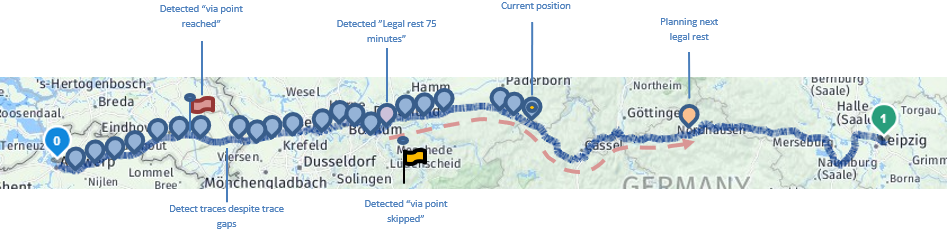
- The driver did or didn't stop to rest.
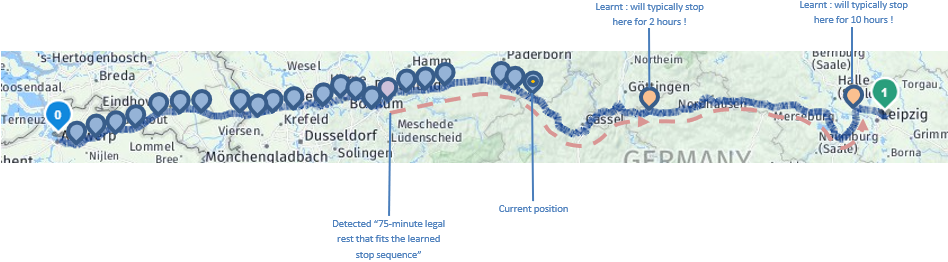
- The service matched the behavior to one of the learned rest patterns for this route.
- Intermediate waypoints were reached or skipped.
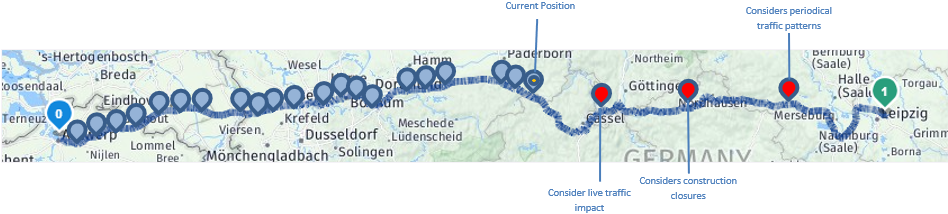
In these conditions, the service continues to provide updated ETA considering these factors:
- Real time traffic and known traffic patterns
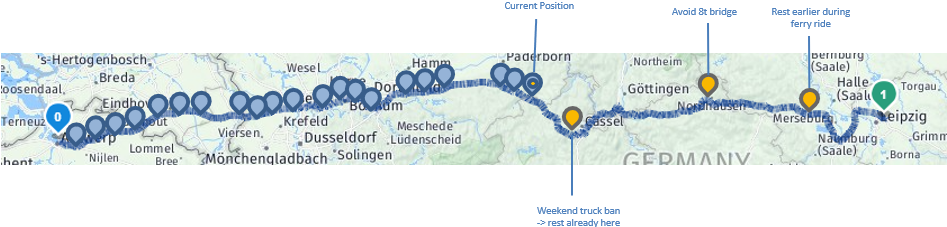
- Truck restrictions on the calculated route
- Country-wide or regional truck bans, including forced rest during that time
- Rest time when on board of a ferry
- The driver's legal rest requirements, including how long they are driving for
- Planned intermediate waypoints
ETA prediction levels
Learning rest patterns
While regulations enforce periodical breaks and rests, drivers can alter the schedules to better fit the current circumstances. Instead of resting at a time or location that was initially planned, they can change the schedule to accommodate:
- Resting at their preferred locations
- Resting at their company logistics hubs
- Resting during loading or unloading the cargo
- Two drivers who change instead of stopping for a rest
- Rules, permissions, or restrictions specific to the driver's logistics company
To get an accurate ETA, the Route Matching API can learn and predict actual rest times and locations and doesn't have to rely only on the provided schedule. You can choose the learning granularity and have the API learn the patterns for specific routes, arrival time slots, drivers, vehicles, or days of the week.
Countering gaps in the trace
Gaps in the trace of the travelled route make it difficult to get accurate ETA estimation. The gaps can be introduced by humans, such as the drivers activating their tracking devices with a delay, or by technical issues, such as network coverage gaps.
The Route Matching API attempts to diminish the impact of these gaps by using pattern learning. For example, a gap in the trace at the beginning of the route can trigger the API to apply a learn pattern that showed that a rest was taken in the missing part of the trace.
Updated 6 months ago