

Waypoints overview
A waypoint is a location that the requested route must traverse.
The origin and destination of a route are waypoints themselves.
Every route must have at least two waypoints: origin and destination.
A route can also have several intermediate waypoints, which are locations between the origin and the destination that the route goes through in the specified sequence.
Intermediate waypoints are specified using the via parameter.
Intermediate waypoint types
There are two types of intermediate waypoints:
- A stopover point: a waypoint at which the journey stops for some time before it continues. This is the default setting for all intermediate waypoints. Can be enabled explicitly through the
passThrough=falseoption. - A passthrough point: a waypoint that doesn't stop the journey, changes the shape of the route only. Enabled through the
passThrough=trueoption.
Waypoint options
In addition to WGS84 coordinates, a waypoint incorporates several other options and details, related to either the physical location point or to the stop itself.
Examples:
- Stopover time
- Navigational hints
- Maneuver instructions
For a full list of waypoint options, refer to the HERE Routing API v8 API reference.
For related sample requests, see these tutorials:
- How to calculate route to the correct side of the street
- How to specify arrival direction at destination
- How to set waypoints based on GPS
Route through intermediate waypoints
To add a waypoint to a route, specify it using the via parameter in your request.
When you add stopover via waypoints (passThrough=false), the route is divided into the following sections:
- From the
originto the firstvia - To any subsequent
via, for every point in the requested order - From the last
viauntil thedestination
When the waypoints don't introduce stops (passThrough=true), the API:
- Doesn't split the route into sections.
- Avoids changing the direction of travel.
You can add the return=passthrough parameter to a route request to get information about passthrough waypoints in the response. This includes the location to which the passthrough waypoint was matched, and an offset into the polyline, if the polyline was requested for that route.
For sample requests that demonstrate waypoint calculation, see these tutorials:
- How to add via waypoints to a route
- Shaping routes with passthrough waypoints
- How to set waypoints based on GPS
- How to specify arrival direction at destination
Matching waypoints
The Routing API matches each requested waypoint location to a navigable location on the map. Waypoint matching depends on various waypoint parameters.
There are two waypoint matching strategies for a waypoint. The strategies are enabled using these parameters:
radiusparameter: matches the waypoint to all segments in the set radius and allows the router to select the one that is optimal for the route.snapRadiusparameter: matches the waypoint to the closest, most "significant" road in the set radius.
These parameters are mutually exclusive on a per-waypoint level. You can use radius for one waypoint and snapRadius for another, but you can't set them both for a single waypoint.
To learn more, see Set waypoints based on UI interactions
location and originalLocation
location and originalLocationThe matched location of a waypoint can be different from the original location requested. The API response contains both the original requested location and the matched location:
locationis the navigable location of the waypoint used in route calculation.originalLocationis the original location provided in the API request.
See this example excerpt of a response with location and originalLocation:
"sections": [
  {
    "departure": {
      ...
    },
    "arrival": {
      "time": "2024-09-05T09:47:46+02:00",
      "place": {
        "type": "place",
        "location": {
          "lat": 52.5242323,
          "lng": 13.4301462
        },
        "originalLocation": {
          "lat": 52.52426,
          "lng": 13.43
        },
        "waypoint": 0
      }
    },
    ...
  }
]
Junction snapping
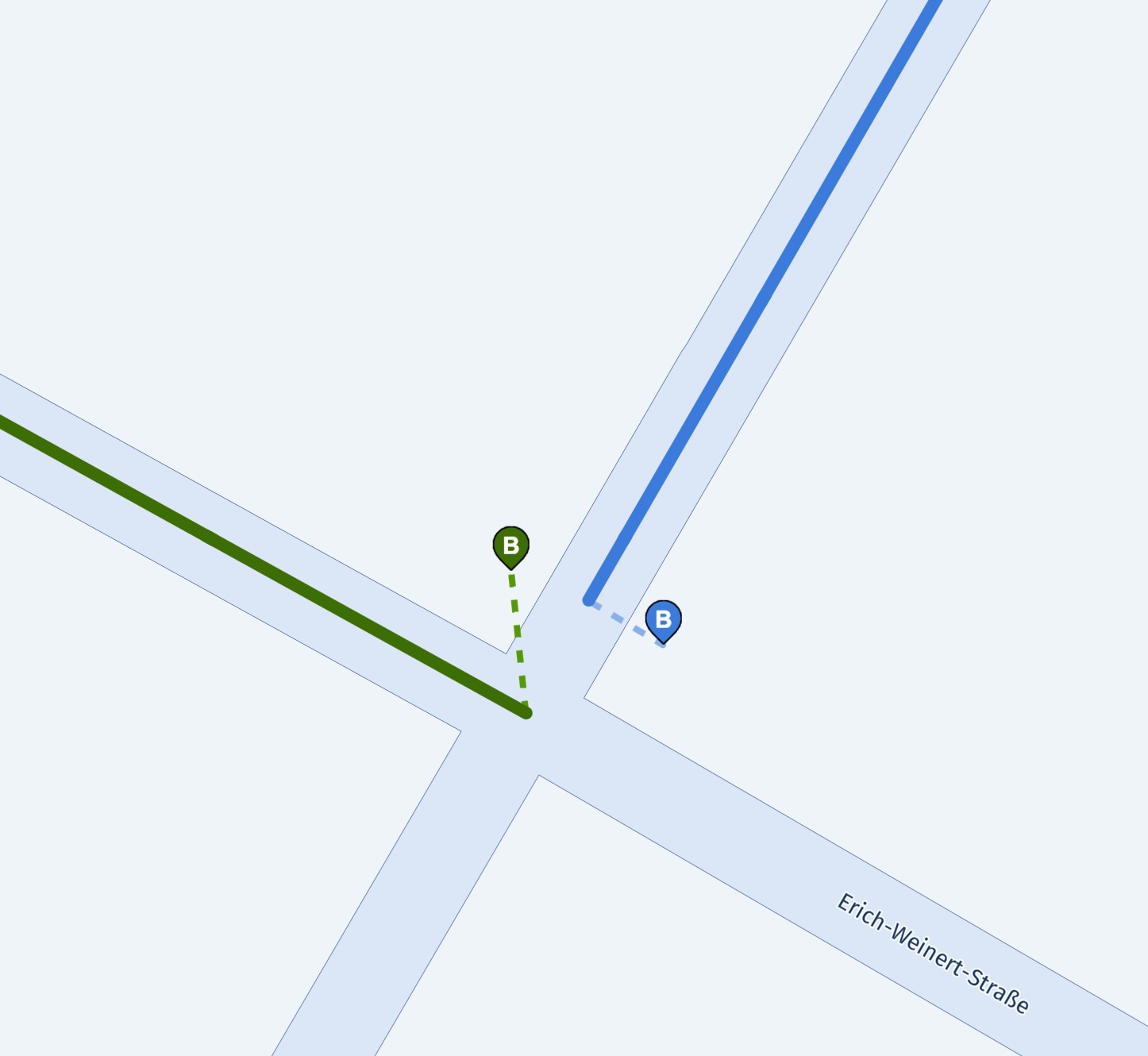
When a waypoint is near a junction, the Routing API snaps it to the junction instead of the nearest point on the nearest road segment. This helps avoid unnecessary maneuvers at the start or end of the route.
The following requests show how location and originalLocation can differ when the same destination near a junction is approached from different directions.
Request:
curl -gX GET 'https://router.hereapi.com/v8/routes?'\
'origin=52.546786,13.431576&'\
'destination=52.546289,13.433105&'\
'return=polyline,summary&'\
'transportMode=car&'\
'apiKey=YOUR_API_KEY'
Response:
{
  "routes": [
    {
      "sections": [
        {
          "arrival": {
            "time": "2026-06-15T13:22:06+02:00",
            "place": {
              "type": "place",
              "location": {
                "lat": 52.5462599,
                "lng": 13.4331099
              },
              "originalLocation": {
                "lat": 52.546281,
                "lng": 13.433131
              }
            }
          }
        }
      ]
    }
  ]
}
Request:
curl -gX GET 'https://router.hereapi.com/v8/routes?'\
'origin=52.547007,13.433776&'\
'destination=52.546274,13.433156&'\
'return=polyline,summary&'\
'transportMode=car&'\
'apiKey=YOUR_API_KEY'
Response:
{
  "routes": [
    {
      "sections": [
        {
          "arrival": {
            "time": "2026-06-15T13:23:47+02:00",
            "place": {
              "type": "place",
              "location": {
                "lat": 52.5462812,
                "lng": 13.43313
              },
              "originalLocation": {
                "lat": 52.546281,
                "lng": 13.433131
              }
            }
          }
        }
      ]
    }
  ]
}
Pedestrian network matching
If a waypoint is near a pedestrian road but not near a road navigable for the requested transport mode, the Routing API follows the pedestrian network to find the nearest navigable road.
curl -gX GET 'https://router.hereapi.com/v8/routes?'\
'origin=52.480753,13.42312&'\
'destination=52.480590,13.404729&'\
'return=polyline,summary&'\
'transportMode=car&'\
'apiKey=YOUR_API_KEY'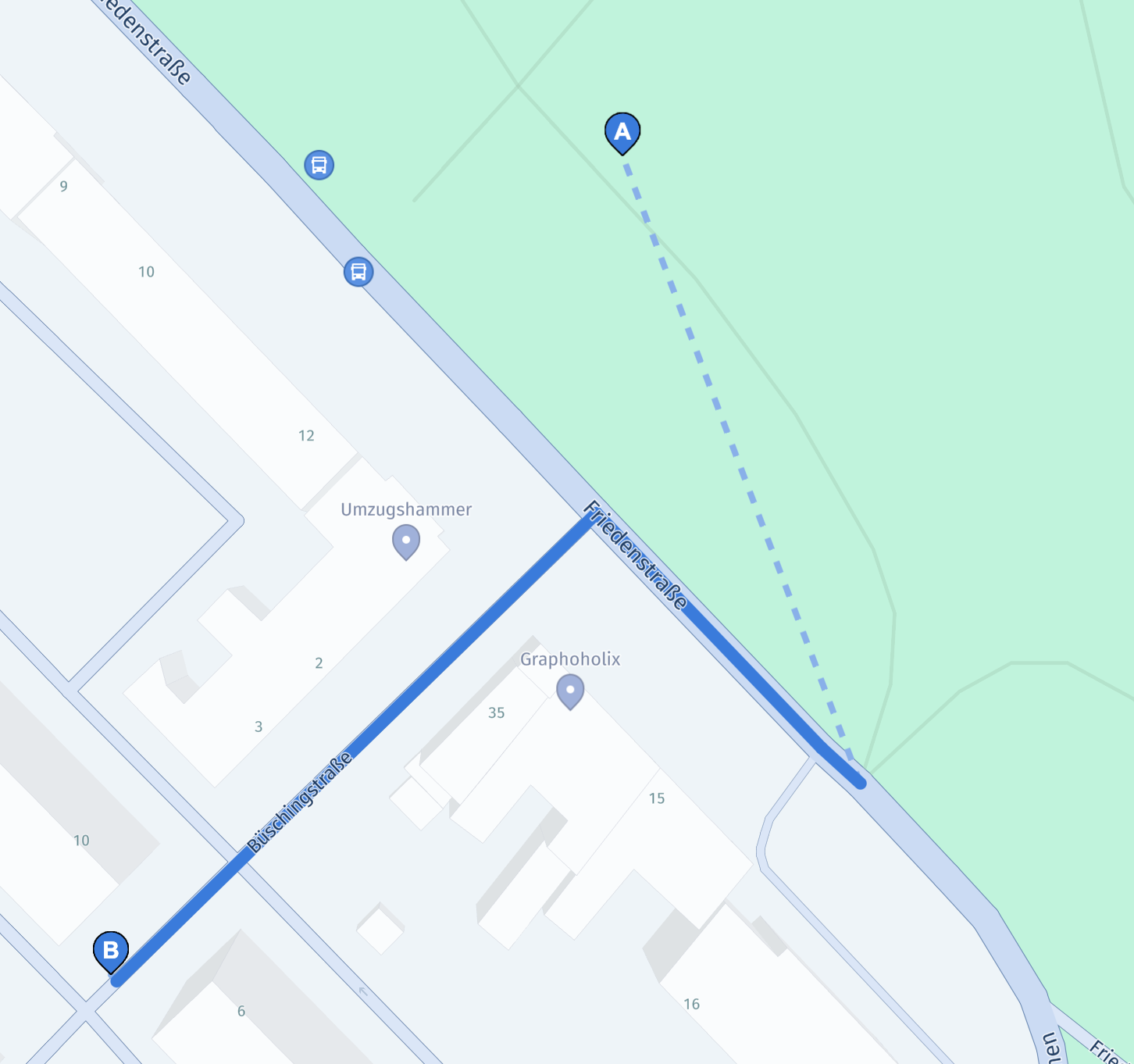
Maximum number of waypoints
The maximum number of waypoints for a route is limited by the maximum length of the HTTP request. Depending on the number of options and their textual length, the number of waypoints you can fit in a request can change.
It's recommended to add no more than 100 waypoints to a single route request.
Route matching
To realize a route matching use case and re-create routes with coordinates coming from a GPS trace or an existing route, you need a high number of waypoints.
To achieve this, use the /import endpoint, as it supports a much larger number of points in the input.
To learn more about /import endpoint, see How to import a route from traces.
Updated 16 days ago