
Build HERE Maps with React
Note
The 3.1 version of this API has been deprecated. For continued support and feature development, upgrade to the latest 3.2 version.
By combining the HERE Maps API for JavaScript with React functional components, you can create interactive web applications that provide a seamless user experience and are easy to maintain because you can reuse components throughout an application to reduce code duplication.
Maps often require a lot of customization to properly adjust them to your specific business needs. By building maps as React components, you can encapsulate even the most complex customizations within a single component, making maps easier to manage and reuse.
The following tutorial uses the Vite tool to create and develop a basic React application with the HERE Maps API for JavaScript.
Set up a new React app with Vite
Set up a new React application by using the Vite tool that provides a quick way to get started building single-page applications.
-
In the root project folder, start a command line tool of your choice, for example, Windows Power Shell or the Command Prompt.
-
Initiate a new React project by entering the following command:
npm create vite@latest my-react-app -- --template reactEnter
yif the terminal displays the prompt to install thecreate-vite@<verison>.This commands sets up the necessary project scaffolding by creating an app folder.
-
Set the app folder as the working directory by entering the following command:
cd my-react-app -
Install the
npmpackage manager by entering the following command:npm install
With the Vite setup completed, you can now create a React map component for displaying HERE maps.
Import the HERE JavaScript API libraries
Import the libraries required to run the HERE maps in the index.html file.
-
In the main
<app>folder, open theindex.htmlfile by using a code editor. -
Replace the default contents of the file with the following HTML code:
<!-- my-react-app/index.html -->
<!doctype html>
<html lang="en">
<head>
   <script type="text/javascript" src="https://js.api.here.com/v3/3.1/mapsjs-core.js"></script>
   <script type="text/javascript" src="https://js.api.here.com/v3/3.1/mapsjs-harp.js"></script>
   <script type="text/javascript" src="https://js.api.here.com/v3/3.1/mapsjs-service.js"></script>
   <script type="text/javascript" src="https://js.api.here.com/v3/3.1/mapsjs-mapevents.js"></script>
   <script type="text/javascript" charset="utf-8" src="https://js.api.here.com/v3/3.1/mapsjs-ui.js" ></script>
   <link rel="stylesheet" type="text/css" href="https://js.api.here.com/v3/3.1/mapsjs-ui.css" />
</head>
<body style="position: absolute; height: 100%; width: 100%; overflow: hidden; margin: 0; padding: 0">
   <div id="root"></div>
   <script type="module" src="/src/main.jsx"></script>
</body>
</html>
Create a map component
Create a React component that uses the HERE Maps API for JavaScript to display the map inside a <div> by using the ref system to directly access and interact with DOM elements.
-
In the
<app>/srcdirectory, add acomponentsdirectory. -
In the
componentsdirectory, create a JSX file, for example.HereMap.jsx, and then open that file by using a code editor. -
In the JSX file, provide the code for rendering the map component. The following example demonstrates how to render a basic vector map using the HARP engine:
// src/components/HereMap.jsx
import { useEffect, useRef } from 'react';

// Stores the DOM node (mapRef) that contains the map
const HereMap = () => {
const mapRef = useRef(null);

// Initializes the HERE map once after mount
useEffect(() => {
   const platform = new window.H.service.Platform({
      apikey: 'YOUR_HERE_APIKEY',
   });

   // Define the engine type:
   const engineType = H.Map.EngineType['HARP'];

   // Obtain the default map types from the platform object:
   const defaultLayers = platform.createDefaultLayers({engineType});

   // Instantiate (and display) a map:
   const map = new window.H.Map(mapRef.current, defaultLayers.vector.normal.map, {
      center: { lat: 52.5200, lng: 13.4050 },
      zoom: 10,
      engineType,
      pixelRatio: window.devicePixelRatio || 1,
   });

   // Enable dynamic resizing of the map, based on the current size of the enclosing cntainer
   window.addEventListener('resize', () => map.getViewPort().resize());

   // MapEvents enables the event system.
   // The behavior variable implements default interactions for pan/zoom
   // Also on mobile touch environments).
   const behavior = new window.H.mapevents.Behavior(
      new window.H.mapevents.MapEvents(map)
   );

   // Create the default UI:
   const ui = window.H.ui.UI.createDefault(map, defaultLayers);

   return () => map.dispose();
}, []);

// Return the map component with the map size set to
// the full height and width of the browser window
return (
   <div
      ref={mapRef}
         style={
           {
             width: '100vw',
             height: '100vh'
           }
         }
   />
  );
};

export default HereMap;
Import the React component
Configure the main application entry point to use the React component with the map.
-
From the
<app>/srcdirectory, open theApp.jsxfile. -
Replace the default file contents with the following code:
// my-react-app/src/App.jsx
import HereMap from './components/HereMap';

function App() {
return (
   <div>
      <HereMap />
   </div>
  );
}

export default App;
Display the map
To preview your map, run the development server for your React app. The npm run dev command starts a fast local web server at the default port.
-
Start the app by entering the following command:
npm run devAs a result of this command, Vite bundles the app and enables viewing the map in a browser. In addition Vite reloads the page or updates modules instantly when you make edits.
-
Open a web browser and then navigate to
http://localhost:5173/.
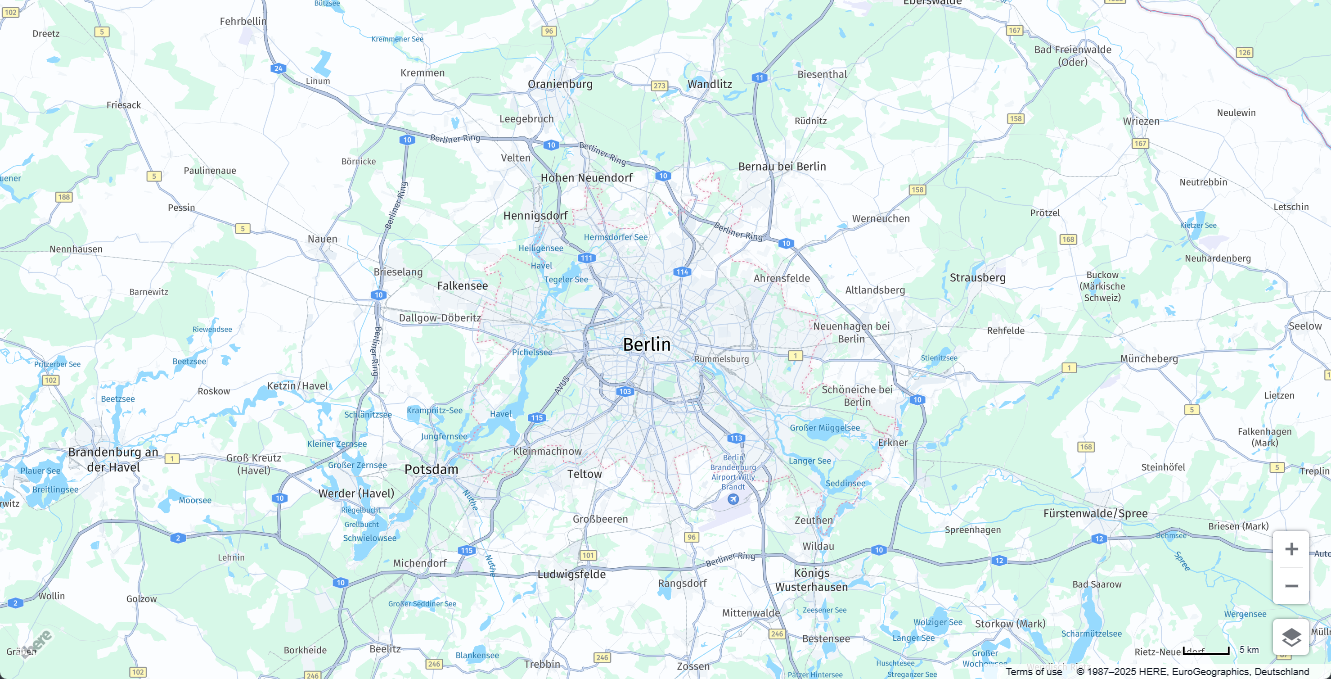
Result: The browser displays the map, as shown in the following example:
Optional: Configure additional map components
Improve the usability of your application by incorporating additional map components that provide more features. To achieve this, follow these steps to add a button that enables or disables public transit information display, leveraging the features and modes capabilities of the HERE Maps API for JavaScript.
To add the toggle, you need to create additional components, as well as update the existing ones to accommodate additional functionality. The resulting directory structure will look as follows:
src/
├── main.jsx
├── App.jsx
└── components/
    ├── HereMap.jsx
    ├── HereMapContext.jsx <-- Manges the state of different components
    └── PublicTransitToggle.jsx <-- Controls the toggle logic and button styling
Manage shared state
Create the HereMapContext component to enable the communication between the HereMap and PublicTransitToggle components while maintaining principle of separated concerns.
-
In the
src/componentsdirectory, create theHereMapContext.jsxfile and open it in a code editor. -
Populate the file with code, as shown in the following example:
// src/components/HereMapContext.jsx
import { createContext, useContext, useRef, useState } from 'react';

const HereMapContext = createContext();

export const HereMapProvider = ({ children }) => {

// Holds the HERE map style object
const styleRef = useRef(null);

// Tracks whether the map style is ready
const [isReady, setIsReady] = useState(false);

return (
   <HereMapContext.Provider
      value={
        {
         styleRef,
         isReady,
         setIsReady
        }
      }
   >
      {children}
   </HereMapContext.Provider>
  );
};

// Custom hook that lets any component access the HERE map and style
export const useHereMap = () => useContext(HereMapContext);
Update the map component to share context and style status
Extract the style object and save it to styleRef for global access. Only after the map style is ready can you modify by adding or removing components.
-
From the
src/componentsdirectory, open theHereMap.jsxfile. -
Update the file to pull in the context information from the
HereMapContextcomponent and ensure the style information can be accessed globally. See the following sample for the updated version of theHereMapcomponent logic:// src/components/HereMap.jsx import { useEffect, useRef } from 'react'; import { useHereMap } from './HereMapContext'; // Obtain the context const HereMap = () => { const mapRef = useRef(null); const { styleRef, setIsReady } = useHereMap(); // Get the context setters useEffect(() => { const platform = new window.H.service.Platform({ apikey: 'YOUR_API_KEY' }); const engineType = window.H.Map.EngineType.HARP; const defaultLayers = platform.createDefaultLayers({ engineType }); const map = new window.H.Map(mapRef.current, defaultLayers.vector.normal.map, { center: { lat: 52.52, lng: 13.405 }, zoom: 10, engineType, pixelRatio: window.devicePixelRatio || 1, }); new window.H.mapevents.Behavior(new window.H.mapevents.MapEvents(map)); window.H.ui.UI.createDefault(map, defaultLayers); const baseLayer = map.getBaseLayer(); const style = baseLayer.getProvider().getStyle(); // Enable other components to use the style once it is ready if (style) { styleRef.current = style; setIsReady(true); } window.addEventListener('resize', () => map.getViewPort().resize()); return () => map.dispose(); }, [styleRef, setIsReady]); return ( <div ref={mapRef} style={ { width: '100vw', height: '100vh' } } /> ); }; export default HereMap;
Create the toggle logic
To promote modularity and reusability, add the PublicTransitToggle component separately. This component controls whether to display or hide the public transit feature from the map view.
-
In the
src/componentsdirectory, add thePublicTransitToggle.jsxfile and open it by using a code editor. -
Configure the toggle logic, as shown in the following example:
// src/components/PublicTransitToggle.jsx

import { useState } from 'react';
import { useHereMap } from './HereMapContext';

const PublicTransitToggle = () => {
const { styleRef, isReady } = useHereMap(); // Access shared map state
const [enabled, setEnabled] = useState(false); // Track toggle state

const toggleTransit = () => {
   if (!isReady || !styleRef.current) {
      console.warn('Map style is not ready yet');
      return;
   }

   const style = styleRef.current;
   const feature = 'public transit';
   const mode = 'all systems';

   const enabledFeatures = style.getEnabledFeatures();
   const featureIndex = enabledFeatures.findIndex(f => f.feature === feature);

   if (featureIndex === -1) {
      // Enable the feature
      enabledFeatures.push({ feature, mode });
      setEnabled(true);
   } else {
      // Disable the feature
      enabledFeatures.splice(featureIndex, 1);
      setEnabled(false);
   }

   style.setEnabledFeatures(enabledFeatures);
};

// Returns the button with the associated styling, depending on the toggle state
return (
   <button
      onClick={toggleTransit}
      disabled={!isReady}
      style={
        {
         position: 'absolute',
         top: '20px',
         left: '20px',
         zIndex: 1000,
         padding: '10px 20px',
         fontSize: '14px',
         fontWeight: '700',
         fontFamily: 'Roboto, Helvetica Neue, Arial, sans-serif',
         backgroundColor: isReady ? (enabled ? '#1A73E8' : '#f4f6f9') : '#e0e0e0',
         color: isReady ? (enabled ? '#ffffff' : '#1A73E8') : '#aaa',
         border: `2px solid ${isReady ? '#1A73E8' : '#ccc'}`,
         borderRadius: '6px',
         cursor: isReady ? 'pointer' : 'not-allowed',
         transition: 'all 0.2s ease-in-out',
         boxShadow: isReady ? '0 2px 4px rgba(0,0,0,0.1)' : 'none',
        }
      }
   >
      {enabled ? 'Disable Public Transit' : 'Enable Public Transit'}
   </button>
  );
};

export default PublicTransitToggle;
Share state logic across app components
Add the HereMapProvider component that wraps up the app and gives child components access to shared values.
-
From the
srcdirectory, open themain.jsxfile. -
Replace the default code with the following logic:
// src/main.jsx
import React from 'react';
import ReactDOM from 'react-dom/client';
import App from './App';
import { HereMapProvider } from './components/HereMapContext';

ReactDOM.createRoot(document.getElementById('root')).render(
<React.StrictMode>
   <HereMapProvider>
      <App />
   </HereMapProvider>
</React.StrictMode>
);
Add the toggle component to the app
Ensure that the PublicTransitToggle button works properly by making the corresponding component access the shared map state from the HereMap component.
-
From the
srcdirectory, open theApp.jsxfile by using a code editor. -
Add the button component to your app, as shown in the following example:
import HereMap from './components/HereMap';
import PublicTransitToggle from './components/PublicTransitToggle';

function App() {
return (
   <>
      <HereMap />
      <PublicTransitToggle />
   </>
);
}

export default App;
This update renders both HereMap and PublicTransitToggle at the top level of your app. It ensures that:
- The
HereMapcomponent mounts first, so it can create the HERE map instance and its style. - These values (
mapandstyle) are shared using React Context, specifically through theHereMapProvider. - The
PublicTransitTogglebutton can then access the shared data by calling theuseHereMap()custom hook.
Because both components are part of the same component tree (wrapped by HereMapProvider), they can communicate indirectly.
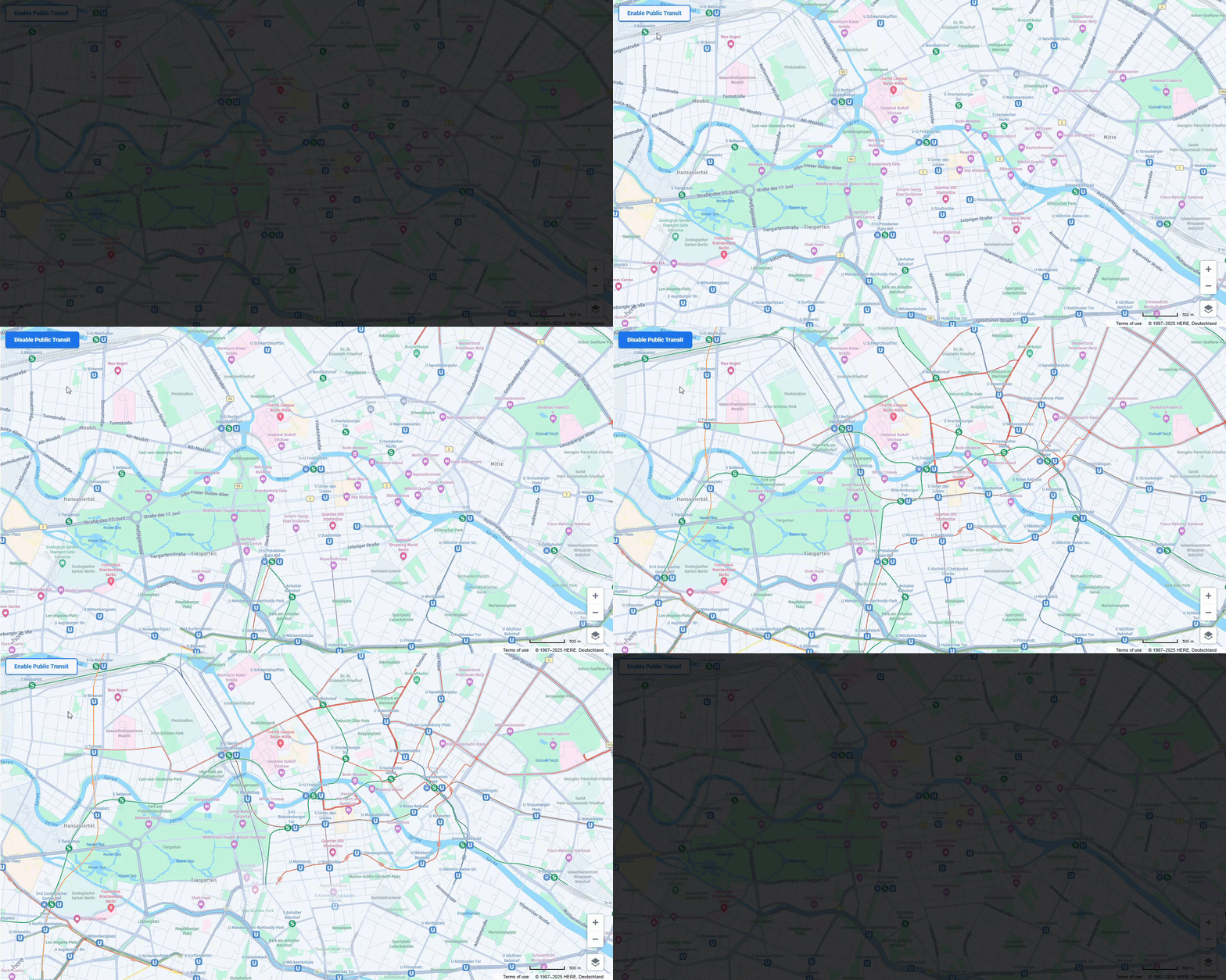
Result: You can now toggle the public transit feature on your map, as shown in the following example:
Next steps
To further explore the design and features of the Maps API for JavaScript, see the API Reference.
Updated last month