

Electronic Horizon
Electronic Horizon uses the map as a sensor to provide a continuous forecast of the upcoming road network by ingesting the map topography that is currently out of the driver’s sight. This functionality can be valuable for advanced navigation, driver-assistance, or ADAS-adjacent features.
Note
Note that this is a beta release of this feature, so there could be a few bugs and unexpected behaviors. Related APIs may change for new releases without a deprecation process.
Main benefits of Electronic Horizon:
- Predictive path awareness: Get early insight into upcoming road segments before a vehicle reaches them. The most preferred path is predicted based on probability.
- Contextual map attributes: Query road signs, speed limits, and road attributes along the horizon.
- Dynamic updates: Automatically load the required map data as the horizon evolves.
- Route and tracking support: Works with a predefined route (map-matched mode) or without a route (tracking mode).
Types of data include:
- Most preferred path (MPP) — the predicted roads most likely to be followed.
- Alternative side paths — possible deviations or branching roads from the MPP.
- Speed limits — speed information along the horizon.
- Road geometry — the polyline representing each upcoming road segment.
- Road classes — classification of roads.
- Road types — specific road characteristics.
- Toll points - upcoming toll structures with payment information.
- Traffic lights - information on upcoming traffic signals.
- ...and more — depending on the configured data loading options. Take a look at the
SegmentDataclass for an overview.
The ElectronicHorizonEngine component fully supports offline use cases when the map data is cached, prefetched, or installed on a device. It works in hybrid mode so that it automatically fetches data online when a device contains no data.
Note
While the HERE SDK provides Electronic Horizon functionality, it currently does not offer direct support for the ADASISv2 and ADASISv3 protocols.
Key Concepts
| Concept | Description |
|---|---|
| Electronic Horizon | A continuously updated model of the road network ahead of the vehicle. |
| Most preferred path (MPP) | The route segment most likely to be followed based on previous location updates or an active route. |
| ElectronicHorizonDataLoader | A utility that automatically loads required map data for segments along the horizon. |
| ElectronicHorizonUpdate | A data structure representing new or changed road segments in the current horizon. |
Similar to the VisualNavigator, you need to update the ElectronicHorizonEngine with a location. However, unlike the VisualNavigator, this location must be map-matched. Therefore, you can use the MapMatchedLocation from the VisualNavigator or Navigator.
The ElectronicHorizonEngine class accepts an ElectronicHorizonListener to notify about the MPP ahead. This listener asynchronously delivers an ElectronicHorizonUpdate, which initially contains only empty lists.
The listener updates the ElectronicHorizonUpdate instance with each call, so clients need to maintain only one instance. At any given time, it represents the current known state of the electronic horizon through the following lists:
electronicHorizonPaths: Holds the complete electronic horizon path tree based onElectronicHorizonOptionsand current vehicle position.ElectronicHorizonDataLoadedStatusindicates when the tree is fully loaded. With the next update, a new path tree is generated that will be partially loaded - and so on.addedSegments: Holds segments added since the previous update. Based on these paths, the data loader will request the desired map data.removedSegmentIds: Holds removed segment IDs since the previous update. TheElectronicHorizonEngineremoves segments based on thetrailingDistanceInMeterswhen they fall behind the vehicle. Segments are also removed when they pass the decision point for side paths.
Use the ElectronicHorizonDataLoaderStatusListener to get notified when new data is loaded.
A typical sequence flow may look like this:
ElectronicHorizonListenerprovides the firstElectronicHorizonUpdate.- Load that update via
ElectronicHorizonDataLoader. ElectronicHorizonDataLoaderStatusListenernotifies when the update contains new or changed data.ElectronicHorizonListenerprovides an updatedElectronicHorizonUpdatebased on the previous one.- Repeat step 2 — load that update, and so on.
Note that there is no guarantee that each ElectronicHorizonUpdate is immediately followed by an ElectronicHorizonDataLoadedStatus. For example, you may receive two consecutive ElectronicHorizonUpdate events and only afterwards receive two ElectronicHorizonDataLoadedStatus events.
Integrate the Electronic Horizon API
Before integrating the Electronic Horizon API, make sure you have the following prerequisites:
- Integrate the HERE SDK into your project.
- Initialize the
SDKNativeEngineor reuse an existing instance. - Ensure you already have a
VisualNavigatororNavigatorsupplying map-matched locations (for accurate horizon updates). - Optionally, use a
RoutePrefetcherto fetch map data for offline use, or use theMapDownloaderto install the region data needed for your trip. If no map data is found on the device, the Electronic Horizon API will fetch the required map data online.
Now, let's start the integration — from initialization to updates and data retrieval.
Create and configure the ElectronicHorizonEngine instance
Use the ElectronicHorizonEngine class to open the horizon model. You can choose whether to pass an active Route or null for tracking mode without following a route.
In this example, we enable the electronic horizon in car mode, but other transport modes are also supported.
let lookAheadDistancesInMeters = [1000.0, 500.0, 250.0]
let trailingDistanceInMeters = 500.0
let electronicHorizonOptions = ElectronicHorizonOptions(
    lookAheadDistancesInMeters: lookAheadDistancesInMeters,
    trailingDistanceInMeters: trailingDistanceInMeters
)

let transportMode = TransportMode.car

do {
    electronicHorizonEngine = try ElectronicHorizonEngine(
        sdkEngine: ElectronicHorizonHandler.getSDKNativeEngine(),
        options: electronicHorizonOptions,
        transportMode: transportMode,
        route: route
    )
} catch let instantiationError {
    fatalError("ElectronicHorizonEngine is not initialized: \(instantiationError)")
}
The ElectronicHorizonEngine uses ElectronicHorizonOptions to define:
lookAheadDistancesInMetersfor the main and side paths: The first entry of the list is for the most preferred path, the second is for the side paths of the first level, the third is for the side paths of the second level, and so on. Each entry defines how far ahead the path should be provided. Each distance must be greater than 0 meters and there is no fixed upper limit. Values are not clamped: a value of 0 or less is treated as invalid and is not applied.- A
trailingDistanceInMetersdefining when past segments are removed: Segments will be removed by the HERE SDK once passed and the distance to them exceedstrailingDistanceInMeters. The value must be greater than 0 meters and is not clamped: a value of 0 or less is treated as invalid and is not applied.
The HERE SDK automatically maintains a list of segments ahead. Each time the horizon changes, the ElectronicHorizonListener is notified.
Update with map-matched location
You must continuously update the ElectronicHorizonEngine with a MapMatchedLocation from the VisualNavigator or Navigator.
electronicHorizonEngine.update(mapMatchedLocation: mapMatchedLocation)Each update recalculates the preferred paths ahead based on the current position and direction.
Get notified on added paths ahead
Before you can load data, you need to know what roads are ahead. For this, create a delegate to get notified asynchronously about electronic horizon updates as a user moves forward. This informs about the available segment IDs and indexes so that the actual data can be requested by the ElectronicHorizonDataLoader later on:
private func createElectronicHorizonDelegate() -> ElectronicHorizonDelegate {
    class EHDelegate: ElectronicHorizonDelegate {
        weak var handler: ElectronicHorizonHandler?

        init(handler: ElectronicHorizonHandler) {
            self.handler = handler
        }

        func onElectronicHorizonUpdated(error: ElectronicHorizonError?, update: ElectronicHorizonUpdate?) {
            guard error == nil, let electronicHorizonUpdate = update else {
                print("(ElectronicHorizonHandler.LOG_TAG): ElectronicHorizonUpdate error: \(String(describing: error))")
                return
            }

            // Store last known horizon if present.
            if electronicHorizonUpdate.electronicHorizon != nil {
                handler?.lastRequestedElectronicHorizon = electronicHorizonUpdate.electronicHorizon
            }
            // Asynchronously start to load required data for the new segments.
            // Use the ElectronicHorizonDataLoaderStatusDelegate to get notified when new data is arriving.
            if let segmentChanges = update.segmentChanges {
                handler?.electronicHorizonDataLoader.loadData(electronicHorizonUpdate: electronicHorizonUpdate)
            }
        }
    }
    return EHDelegate(handler: self)
}
Make sure to add the delegate to the ElectronicHorizion instance.
Create and configure a data loader
The ElectronicHorizonDelegate provides updates that can then be loaded. For this, you need to instantiate an ElectronicHorizonDataLoader to load asynchronously detailed map data for horizon segments. It accepts SegmentDataLoaderOptions, which let you define which data to include.
// Many more options are available, see SegmentDataLoaderOptions in the API Reference.
var segmentDataLoaderOptions = SegmentDataLoaderOptions()
segmentDataLoaderOptions.loadRoadSigns = true
segmentDataLoaderOptions.loadSpeedLimits = true
segmentDataLoaderOptions.loadRoadAttributes = true
segmentDataLoaderOptions.loadStreetNamesAndRoadNumbers = true
// Enable polyline loading when segment geometry is needed for visualization.
segmentDataLoaderOptions.loadPolyline = true

// The cache size defines how many road segments are cached locally. A larger cache size
// can reduce data usage, but requires more storage memory in the cache.
// A small cache can replace previously loaded segments too early.
let segmentDataCacheSize = 1000
do {
    electronicHorizonDataLoader = try ElectronicHorizonDataLoader(
        sdkEngine: ElectronicHorizonHandler.getSDKNativeEngine(),
        options: segmentDataLoaderOptions,
        segmentDataCacheSize: Int32(segmentDataCacheSize)
    )
} catch let instantiationError {
    fatalError("ElectronicHorizonDataLoader is not initialized: \(instantiationError)")
}Note
A small cache can replace previously loaded segments too early. This can lead to logs such as
DirectedOCMSegmentId ... internal error: not found in cachewhen segment data is queried later. In such cases, consider increasingsegmentDataCacheSize(for example, to1000) to reduce segment eviction.
For convenience, the ElectronicHorizonDataLoader wraps a SegmentDataLoader that continuously loads the required map data segments based on the most preferred path(s) of the ElectronicHorizonEngine.
As a second step, you probably also want to handle newly arriving map data segments provided by the ElectronicHorizonDataLoader. For this, you can create an ElectronicHorizonDataLoaderStatusListener. The HERE SDK calls this delegate when the data loader’s status updates and new segments are loaded.
/// Handle newly arriving map data segments provided by the ElectronicHorizonDataLoader.
/// This delegate is called when the status of the data loader is updated and new segments have been loaded.
private func createElectronicHorizonDataLoaderStatusDelegate() -> ElectronicHorizonDataLoaderStatusDelegate {
    class EHStatusDelegate: ElectronicHorizonDataLoaderStatusDelegate {
        weak var handler: ElectronicHorizonHandler?

        init(handler: ElectronicHorizonHandler) {
            self.handler = handler
        }

        func onElectronicHorizonDataLoaderStatusUpdated(electronicHorizonDataLoaderStatuses statusMap: [Int32: ElectronicHorizonDataLoadedStatus]) {
            print("\(ElectronicHorizonHandler.LOG_TAG): ElectronicHorizonDataLoaderStatus updated.")
            // Access the loaded segments here.
        }
    }

    return EHStatusDelegate(handler: self)
}
Make sure to add the delegate to the ElectronicHorizonDataLoader instance.
electronicHorizonDataLoader.addElectronicHorizonDataLoaderStatusDelegate(electronicHorizonDataLoaderStatusDelegate)Accessing segment data
After the ElectronicHorizonDataLoaderStatusListener signals via onElectronicHorizonDataLoaderStatusUpdated(...) that segments are fully loaded, you can query individual segments for their attributes.
The statusMap parameter of type [Int32: ElectronicHorizonDataLoadedStatus] contains the following information:
- The integer key represents the level of the most preferred path (0) and side paths (1, 2, ...).
- The status contains information on whether the segment has been fully loaded and is ready to be used, for example, by checking for
ElectronicHorizonDataLoadedStatus.FULLY_LOADED.
Now, access the segments that were part of a previously requested electronic horizon update. The app requested these segments for loading in the call to electronicHorizonDataLoader.loadData(...). The data loader provides a method the get access to the actual data via electronicHorizonDataLoader.getSegment(directedOCMSegmentId.id).
Internally, the data loader tracks which segments the app requested and continuously updates the provided ElectronicHorizonUpdate instance.
The following example waits until the MPP is fully loaded and then iterates over the entire tree:
for (level, status) in statusMap {
    // The integer key represents the level of the most preferred path (0) and side paths (1, 2, ...).
    // This example shows only how to look at the fully loaded segments of the most preferred path (level 0).
    if level == 0 && status == .fullyLoaded {
        // Now, level 0 segments have been fully loaded and you can access their data.
        // The electronicHorizonPaths list contains segments from all levels,
        // so you need to filter for level 0 below.
        for electronicHorizonPath in lastUpdate.electronicHorizonPaths {
            let electronicHorizonPathSegments = electronicHorizonPath.segments
            for segment in electronicHorizonPathSegments {
                // For any segment you can check the parentPathIndex to determine
                // if it is part of the most preferred path (MPP) or a side path.
                if segment.parentPathIndex != 0 {
                    // Skip side path segments as we only want to log MPP segment data in this example.
                    // And we only want to log fully loaded segments.
                    continue
                }

                guard let directedOCMSegmentId = segment.segmentId.ocmSegmentId else {
                    continue
                }

                // Retrieving segment data from the loader is executed synchronous. However, since the data has been
                // already loaded, this is a fast operation.
                let result = handler.electronicHorizonDataLoader.getSegment(segmentId: directedOCMSegmentId.id)
                if result.errorCode == nil, let segmentData = result.segmentData {
                    // Access the data that was requested to be loaded in SegmentDataLoaderOptions.
                    // For this example, we just log road signs.
                    guard let roadSigns = segmentData.roadSigns, !roadSigns.isEmpty else {
                        continue
                    }
                    for roadSign in roadSigns {
                        let roadSignCoordinates = handler.getGeoCoordinatesFromOffsetInMeters(
                            geoPolyline: segmentData.polyline,
                            offsetInMeters: Double(roadSign.offsetInMeters)
                        )
                        print("\(ElectronicHorizonHandler.LOG_TAG): RoadSign: type = \(roadSign.roadSignType.rawValue), offsetInMeters = \(roadSign.offsetInMeters), lat/lon: \(roadSignCoordinates.latitude)/\(roadSignCoordinates.longitude), segmentId = \(directedOCMSegmentId.id.localId)")
                    }
                }
            }
        }
    }
}
To fetch the geographic coordinates from a segment, you can use the provided offset in meters and the helper below:
/// Convert an offset in meters along a GeoPolyline to GeoCoordinates using the HERE SDK's coordinatesAtOffsetInMeters.
private func getGeoCoordinatesFromOffsetInMeters(geoPolyline: GeoPolyline, offsetInMeters: Double) -> heresdk.GeoCoordinates {
    return geoPolyline.coordinatesAt(offsetInMeters: offsetInMeters,
                                     direction: .fromBeginning)
}
Note that segment.parentPathIndex is 0 when it's the MPP. Optionally, you can iterate further down the tree to retrieve information for side paths.
Extract side-street details
The Navigation app extracts side-street details from first-level side streets whose parent is the currently followed navigation path.
- In
onElectronicHorizonDataLoaderStatusUpdated(...), wait forloadedLevel == 1and then callhandler.notifySideStreetInfos(allPaths: allPaths). - Filter paths by
path.level == 1andpath.parentPathIndex == 0. - Read the segment via
electronicHorizonDataLoader.getSegment(segmentId: ...). - Extract the first non-empty label from
SegmentSpanData.streetNamesorSegmentSpanData.roadNumbers. - Resolve a coordinate near the segment start via
GeoPolyline.coordinatesAt(offsetInMeters:direction:).
if loadedLevel == 1 {
    handler.notifySideStreetInfos(allPaths: allPaths)
}private static let SIDE_STREET_LOG_OFFSET_METERS = 20.0
// Finds first-level side streets whose parent is the currently followed navigation path.
private func notifySideStreetInfos(allPaths: [ElectronicHorizonPath]) {
for (pathIndex, path) in allPaths.enumerated() {
if path.level != 1 || path.parentPathIndex == nil || path.parentPathIndex != 0 {
continue
}
guard let sideStreetInfo = findSideStreetInfo(branchingPath: path, pathIndex: pathIndex) else {
continue
}
print("\(Self.LOG_TAG): SideStreetName near active route: \(sideStreetInfo.streetName) at lat/lon: \(sideStreetInfo.coordinateAtOffsetFromSegmentStart.latitude)/\(sideStreetInfo.coordinateAtOffsetFromSegmentStart.longitude), pathIndex=\(sideStreetInfo.pathIndex), segmentLocalId=\(sideStreetInfo.segmentLocalId)")
}
}
private func findSideStreetInfo(branchingPath: ElectronicHorizonPath, pathIndex: Int) -> SideStreetInfo? {
for segment in branchingPath.segments {
guard let directedOCMSegmentId = segment.segmentId.ocmSegmentId else { continue }
let result = electronicHorizonDataLoader.getSegment(segmentId: directedOCMSegmentId)
if result.errorCode != nil || result.segmentData == nil {
continue
}
guard let segmentData = result.segmentData,
let sideStreetName = getFirstStreetLabel(segmentData: segmentData),
let polyline = segmentData.polyline else {
continue
}
let sideStreetCoordinates = polyline.coordinatesAt(
offsetInMeters: Self.SIDE_STREET_LOG_OFFSET_METERS,
direction: .fromBeginning
)
return SideStreetInfo(
streetName: sideStreetName,
coordinateAtOffsetFromSegmentStart: sideStreetCoordinates,
pathIndex: pathIndex,
segmentLocalId: Int64(directedOCMSegmentId.id.localId)
)
}
return nil
}
private func getFirstStreetLabel(segmentData: SegmentData) -> String? {
let segmentSpans = segmentData.spans
if segmentSpans.isEmpty {
return nil
}
for segmentSpanData in segmentSpans {
var streetName = segmentSpanData.streetNames?.defaultValue()
if streetName == nil || streetName!.trimmingCharacters(in: .whitespacesAndNewlines).isEmpty {
streetName = segmentSpanData.roadNumbers?.defaultValue()
}
if let streetName = streetName, !streetName.trimmingCharacters(in: .whitespacesAndNewlines).isEmpty {
return streetName
}
}
return nil
}
If you need side-street data from all branching levels (not only first-level side streets), you can filter with path.level > 0 instead:
private func notifySideStreetInfosForAllLevels(allPaths: [ElectronicHorizonPath]) {
    for (pathIndex, path) in allPaths.enumerated() {
        if path.level <= 0 {
            continue
        }

        guard let sideStreetInfo = findSideStreetInfo(branchingPath: path, pathIndex: pathIndex) else {
            continue
        }

        print("\(Self.LOG_TAG): SideStreetName near active route: \(sideStreetInfo.streetName) at lat/lon: \(sideStreetInfo.coordinateAtOffsetFromSegmentStart.latitude)/\(sideStreetInfo.coordinateAtOffsetFromSegmentStart.longitude), pathIndex=\(sideStreetInfo.pathIndex), segmentLocalId=\(sideStreetInfo.segmentLocalId)")
    }
}
Stop and clean up
When navigation ends or tracking mode stops, remove listeners and release resources.
electronicHorizonEngine.removeElectronicHorizonListener(listener);
electronicHorizonDataLoader.removeElectronicHorizonDataLoaderStatusListener(statusListener);
Track position within the horizon
Every ElectronicHorizonUpdate delivered by ElectronicHorizonDelegate contains a position field of type ElectronicHorizonPosition. This tells you where the vehicle currently sits within the path tree — no separate delegate is needed.
ElectronicHorizonPosition has three properties:
| Property | Description |
|---|---|
pathIndex | Index of the current path in ElectronicHorizon.paths. 0 means the MPP. |
pathSegmentIndex | Index of the segment within ElectronicHorizonPath.segments. |
pathSegmentOffsetInMeters | Offset from the start of that segment in meters. |
class EHDelegate: ElectronicHorizonDelegate {
    func onElectronicHorizonUpdated(errorCode: ElectronicHorizonErrorCode?, update: ElectronicHorizonUpdate?) {
        guard errorCode == nil, let electronicHorizonUpdate = update else { return }

        // Position is always present on every update.
        let position = electronicHorizonUpdate.position
        print("EH position: pathIndex=\(position.pathIndex), pathSegmentIndex=\(position.pathSegmentIndex), offsetInMeters=\(position.pathSegmentOffsetInMeters)")
    }
}
This is useful when you want to know the exact position of the vehicle in the tree — for example, to highlight the current segment or to read real-time attributes for it.
Visualize the Electronic Horizon paths
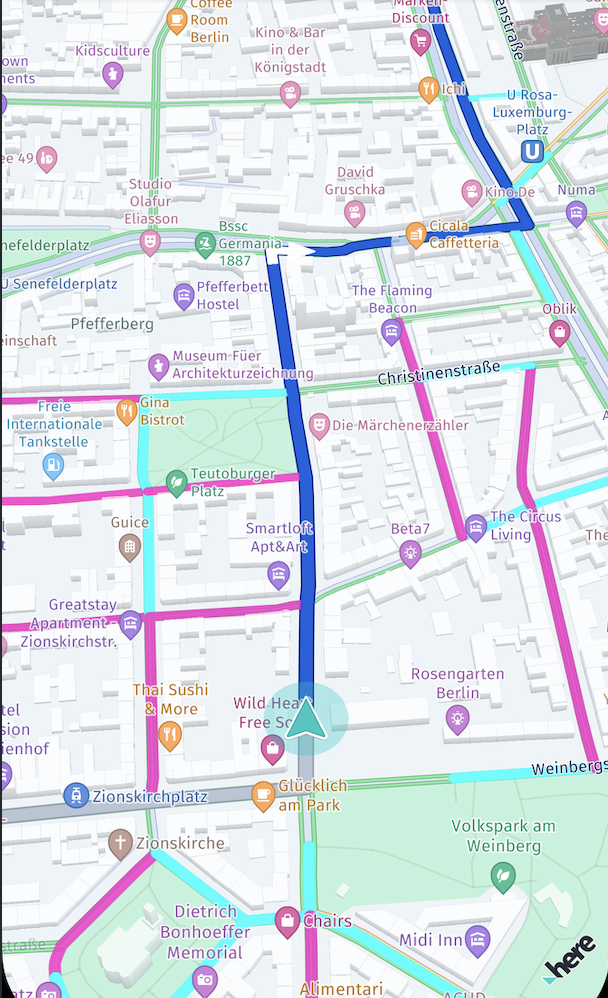
The Electronic Horizon segments can be visualized on the map to aid debugging or to provide a visual representation of the road network ahead. To implement segment visualization in your app, render colored MapPolyline instances for side paths at different levels:
- Main route (MPP) — The most preferred path (
level == 0) is already rendered as the active navigation route and does not need a separate visualization. - First-level side paths (
level == 1) — Cyan color - Second-level side paths (
level == 2) — Pink/Fuchsia color - Third-level side paths (
level == 3) — Orange color - Fourth-level side paths (
level == 4) — Green color
Polylines should be added when segments are loaded and removed when segments leave the horizon (either because the vehicle has passed them beyond trailingDistanceInMeters, or because the vehicle has passed the decision point for that side path).
To find branching side paths, use segment.sidePathIndexes. Each value in this list is an index into lastElectronicHorizon.paths[], pointing to a path that branches off at the end of that segment. Use the branching path's level to assign distinct colors:
let allPaths = lastElectronicHorizon.paths

for path in allPaths {
    for segment in path.segments {
        for sidePathIndex in segment.sidePathIndexes {
            let idx = Int(sidePathIndex)
            guard idx >= 0 && idx < allPaths.count else { continue }
            let branchingPath = allPaths[idx]

            // Draw all segments of this branching path using a color based on its level.
            for branchSegment in branchingPath.segments {
                guard let id = branchSegment.segmentId.ocmSegmentId else { continue }
                let result = electronicHorizonDataLoader.getSegment(segmentId: id)
                guard result.errorCode == nil, let segmentData = result.segmentData else { continue }

                let color: UIColor
                switch branchingPath.level {
                case 1:  color = UIColor(red: 0.0, green: 1.0, blue: 1.0, alpha: 1.0)   // Cyan
                case 2:  color = UIColor(red: 1.0, green: 0.2, blue: 0.8, alpha: 0.85)  // Pink
                case 3:  color = UIColor(red: 1.0, green: 0.65, blue: 0.0, alpha: 0.85) // Orange
                case 4:  color = UIColor(red: 0.0, green: 1.0, blue: 0.0, alpha: 0.85)  // Green
                default: continue // Don't draw levels beyond 4
                }

                do {
                    let mapPolyline = try MapPolyline(
                        geometry: segmentData.polyline,
                        representation: MapPolyline.SolidRepresentation(
                            lineWidth: MapMeasureDependentRenderSize(sizeUnit: RenderSize.Unit.pixels, size: 25.0),
                            color: color,
                            capShape: LineCap.round
                        )
                    )
                    mapView.mapScene.addMapPolyline(mapPolyline)
                } catch {
                    print("MapPolyline instantiation failed: \(error)")
                }
            }
        }
    }
}
Best practices
- Use look-ahead distances and trailing distances that match your use case (e.g., highway vs. urban).
- Process only level 0 (most preferred path) segments unless you actively want side-path data.
- Prefetch map data ahead of time if your app will run offline or in low-connectivity scenarios.
- Choose a reasonable cache size for the data loader to balance memory and performance.
- Remove listeners and free resources when no longer needed to avoid memory leaks or unnecessary background work.
Try the example app
In the "Navigation" example app on GitHub, the ElectronicHorizonHandler class demonstrates how to:
- Initialize and start the
ElectronicHorizonEngine. - Update it with map-matched locations during navigation.
- Retrieve and log road-level data (for example, road signs) as the vehicle moves along a route.
For a full implementation, see ElectronicHorizonHandler.swift.
Updated 13 days ago