

Pipelines and the Data Processing Library
Pipelines and the Data Processing Library
Pipeline is the main abstraction to define, implement and deploy data
processing algorithms and custom logic on the HERE platform.
A PipelineTemplate is a reusable definition of a Pipeline, that includes
the implementation and all the information needed to make it runnable,
such as:
- the entry point, which is the name of the main class
- the definition and schema of the input and output catalogs which the
implementation needs to be connected to - the type of runtime required
- the default configuration and parameters
A Pipeline is instantiated by the Pipeline API for a given PipelineTemplate.
Pipelines are deployed on runtime environments dynamically provided by the
HERE Workspace and are connected to their input and output catalogs.
Pipelines automatically receive the credentials from the Pipeline API to
authenticate to other platform services, such as the Data API, the configuration,
HRNs for each of the expected input and output catalogs and the job description,
when applicable.
The Pipeline API supports runtime environments based on Apache Flink and Apache Spark.
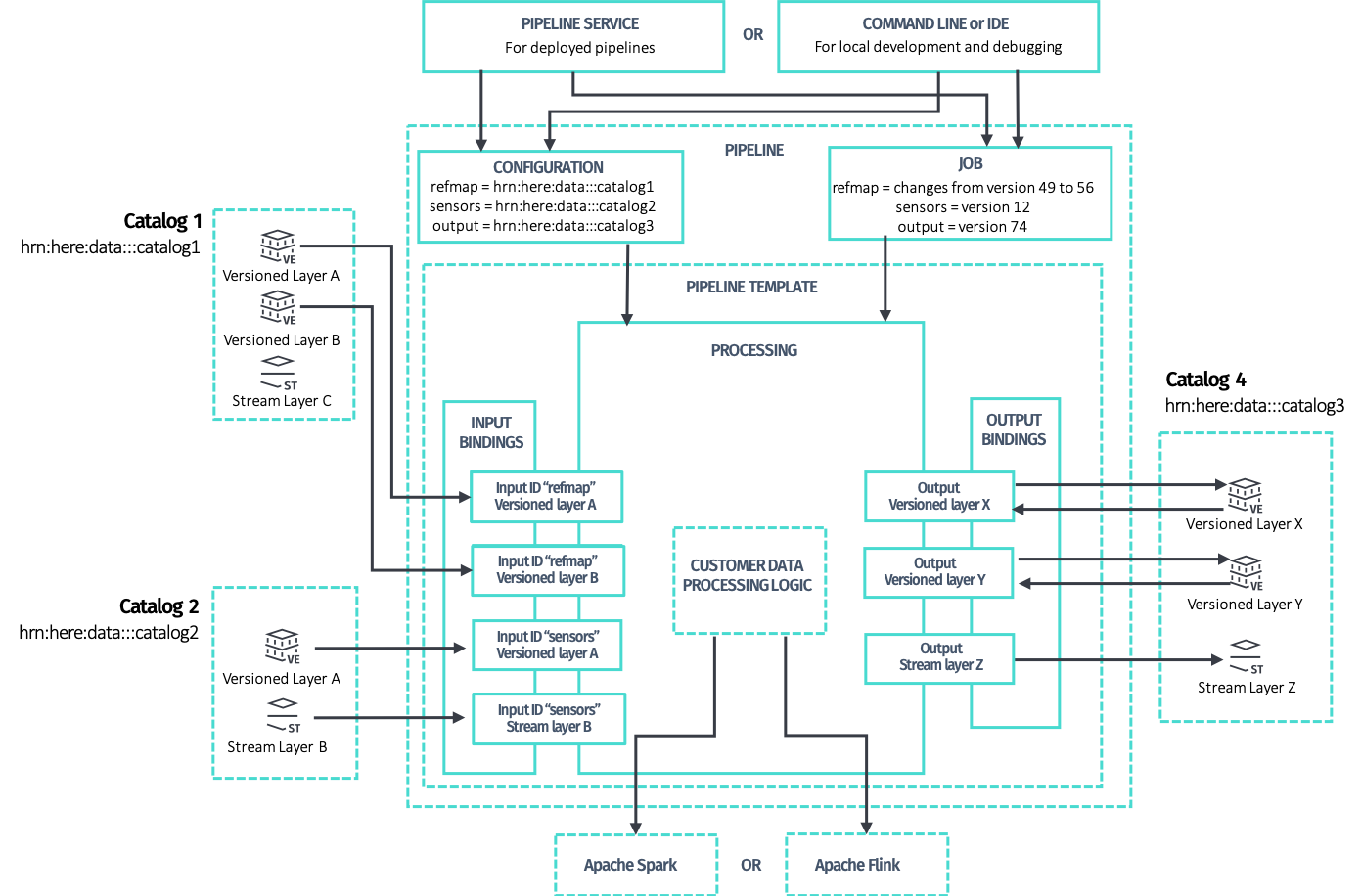
A pipeline implementation assumes the existence of only one output catalog
and one or more input catalogs. Each input catalog is marked by a symbolic,
implementation-specific ID used in the code to differentiate between multiple inputs.
The implementation also implicitly assumes the list and type of the layers for each catalog,
as the code contains logic to read and write to specific layers.
Layers can be of different types:
versionedlayers contain partitioned data; the Data API keeps track of
how each partition evolves over time. A typical use case of versioned layers
is to store a snapshot of a dataset, usually map data, that is updated from
time to time.streamlayers contain live data streams; the Data API exposes streams
as message queues. A typical use case for stream layers is to report events or
sensor readings from vehicles, IoT devices, or other web events and services.volatilelayers contain data similar to versioned layers, but the content
of each partition may change without producing an additional version. A
typical use case for volatile layers is to produce data that varies rapidly
over time, obsoletes quickly, in an efficient way. For example, traffic data.
When run locally or deployed on the platform pipeline, HRNs of each input and output
catalog are provided and the process binds to the actual data instances. This makes
the implementation, and so the pipeline template, reusable.
For more information on pipelines, how they are deployed on the HERE platform, different types of pipelines and runtime environments, how pipelines
are connected together to form topologies, see the Developer's Guide of the Pipeline API.
The Data Processing Library provides abstractions and libraries to implement pipelines.