

Stateful data processing
Stateful data processing
The Data Processing Library lets you process input data snapshots by querying
the current base version of the output catalog. Consequently, you can perform
stateful data processing, where the current input data is processed by taking
into consideration the output produced from the previous run.
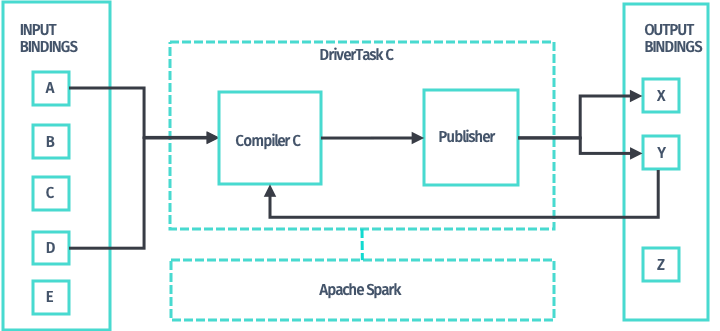
Data from the output catalog at its current version, can be referred to by
using the Default.FeedbackCatalogId identifier, in the same way as the
Default.OutCatalogId and input catalog identifiers are used to refer to the
other output and input layers.
NOTE The feedbackRetriever of the DriverContext interface provides the
functionality to load the required data to perform stateful processing, or
you can access the Retriever for the FeedbackCatalogId through the
inRetriever method of the DriverContext.
NOTE All compilation patterns in the processing library
still apply when you perform stateful processing. Moreover, this feature does not
impact any concept, functionality, or require any special configuration in the
environment where the application runs, typically the
Pipeline API.
Creating the initial state is delegated to the developers using the processing
library. This initial state should be committed to the output catalog before
the application runs. In most cases, it is sufficient to represent the initial
state as an empty output catalog and implement logic in the compiler to define
the initial processing values when the feedback layers contain no data, such as
setting the counter to zero, initializing an object containing some information
to represent the initial state of the processing, and so on.
The feedback catalog is the output catalog version which is produced in the
compiler's last run. You can access earlier versions of the output catalog using
the concepts described in multiple catalog versions.
The section below describes an example of stateful processing, covering
the major design decisions you should consider for this type of data
processing.
Example: POI data changes counter
A Point of Interest (POI) is an object that models a place in the real world.
In this context, places can be shops, tourist attractions, or similar. A POI
may contain one of the following properties:
- id
- type
- geocoordinates (lat, long)
- name
- phone.
Among these properties, we assume that id, type, and the geocoordinates
do not change over time; other information may change across different data
releases.
Suppose we need to count the number of times POIs information have changed
over time. The output catalog contains information related to all POIs ever
stored in the input layer, because we want to keep track of the overall
history for the POIs layer.
This is an example of stateful processing where the result of a previous
elaboration (the current values of the counters) needs to be included as
additional input for the compiler.
In this context, we assume that POIs are stored in a single layer and we want
the output layer to have the same tiling as the input layer.
Design of output layers and feedback layers
For this use case, we have one layer for both the output layer and the feedback
layer. This layer should contain the following properties for each POI:
- id
- name
- phone
- counter that holds the number of times a given POI content changed
The name and phone members are the information that is monitored.
Initial state
In this case, the initial state can consist of an empty output layer. The
compiler's logic should consider any tile or POI that has not yet been
processed as new input, and then set new counter members to zero and fill the
information being monitored.
Processing pattern
Since there is a fixed correspondence between couples of input and feedback
keys versus a single output layer key, the most suitable processing pattern is
the Direct M:N pattern described in
Direct 1:N and M:N Compilers.
Processing logic
The processing logic works on a tile basis. The output tile content is
initialized to contain the current feedback tile content, when available. The
empty output catalog is considered a valid initial state.
For each POI in the input layer:
- if the POI is not in the feedback layer:
- add a new entry to the output layer by setting its counter to zero and the
id, the name, and the phone to the value of the POI
- add a new entry to the output layer by setting its counter to zero and the
- else if the name and/or the phone changed:
- update the changed information in the output layer and increase the counter
by 1
- update the changed information in the output layer and increase the counter
Note that running the above processing a second time, on a given input produces
no changes in the output layer. This is the desirable property for stateful
processing where the output converges for a given configuration in one step.