

How to use the routing graph
How to use the routing graph
Path matching is one of the most important algorithms provided by the Location
Library. This algorithm frequently queries for information about the road
network. So the response to such a request must be returned quickly.
The HERE Map Content topology graph
The Road Topology and Geometry Layer of HERE Map Content stores a graph. This
graph is called the topology graph and models the road network. This model
consists of two types of elements:
- A node represents a junction.
- A segment represents a road that connects two junctions.
NoteTo inspect the topology graph, open
https://platform.here.com/data/hrn:here:data::olp-here:rib-2/topology-geometry/inspect
in a web browser.
Each node or segment of the topology graph has a unique identifier. A node or
segment identifier is a string that does not change between map versions, except
if the corresponding element itself changes. HERE Map Content uses these
identifiers to associate properties of the road network to nodes or segments.
The storage of properties was not optimized to retrieve properties for a
particular node or segment: retrieving properties for a particular node or
segment requires scanning all the properties in the relevant partition.
The Location Library routing graph
The Location Library uses a different graph to model the road network. This
graph is called the routing graph and is derived from the topology graph of
HERE Map Content.
The routing graph models the road network with the following two types of
elements:
- A vertex represents travel in a particular direction along a road segment.
- An edge represents a possible transition from one vertex to another.
The following picture illustrates the difference between the topology graph and
the routing graph:
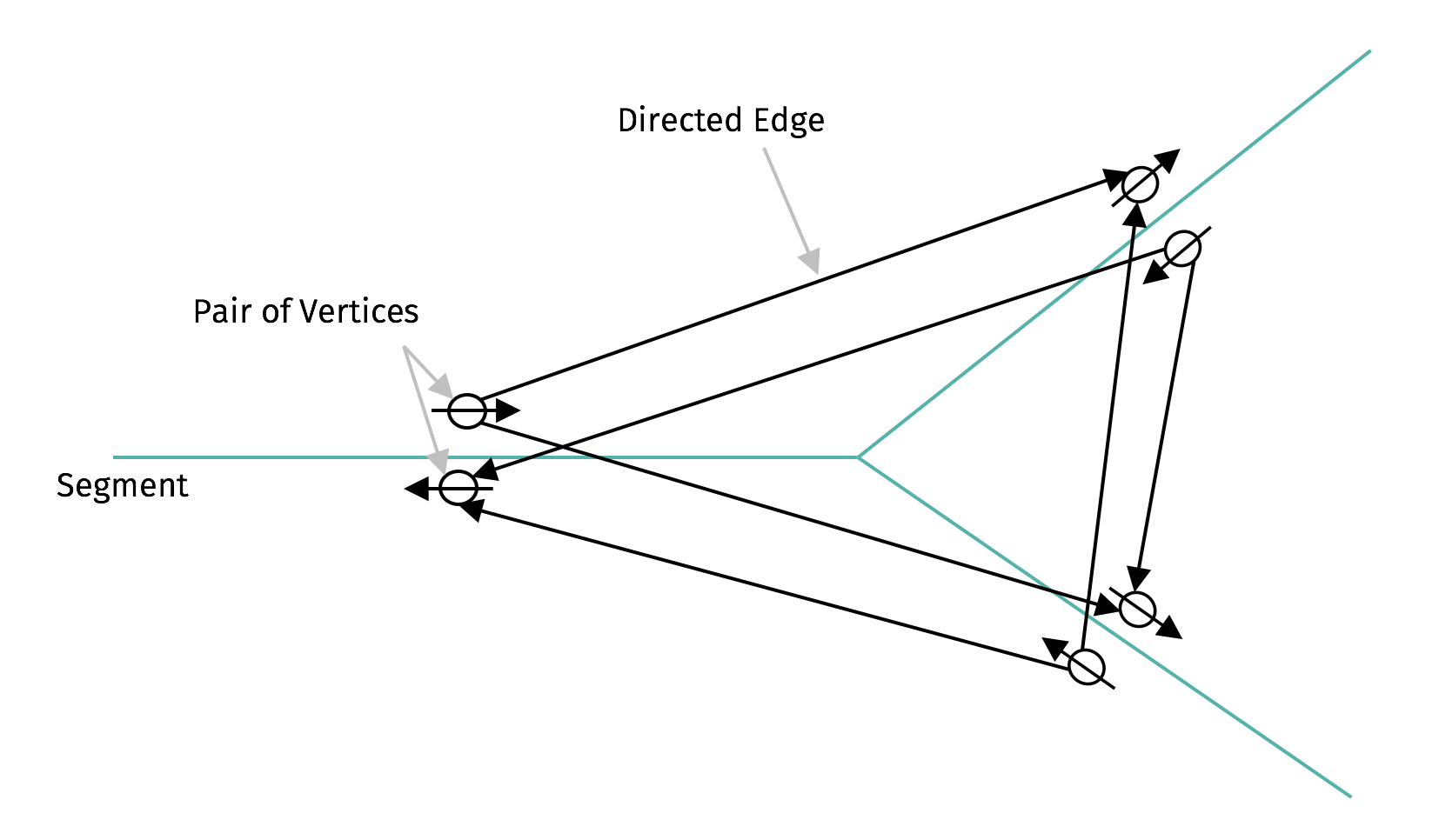
Each vertex is identified by a tile ID and a vertex index. Vertex indices are
positive integers that the Location Library can use to store vertex properties
into arrays. An access to a property in an array is faster than in a HERE Map
Content partition because the latter requires a scan of all properties in this
partition.
On the other hand, vertex indices may change between two successive versions of
a map. Therefore, do not use vertex indices as persistent identifiers, use
segment identifiers instead.
The same comments and considerations apply to nodes (topology graph) and edges
(routing graph). For more information about vertex and edge properties, see
Graph Properties.