

Spark RDD-based patterns
RDD-based patterns
Despite being more cumbersome to implement, RDD-based patterns provide more
freedom, such as the freedom to implement the actual business logic that
leverages Spark operations: joining, filtering, mapping, and so on. These operations
not only reduce the metadata, but the actual data as well.
Functional patterns use Spark to parallelize the function applications, but
these functions cannot see the RDDs. In contrast, RDD-based patterns have RDDs
as parameters and return values for the interfaces that should be implemented.
However, there is one important drawback: compiler implementations must
actively support incremental compilation. This means that this key Data
Processing Library feature is not fully transparent: compilers shall cooperate
and return additional RDDs that contain the information requested by each
pattern for the compiler to complete the job and support incremental processing
properly. Failing to do so, or returning an RDD that does not follow what the
pattern specification expects, results in invalid maps being produced when the
compiler is run incrementally.
The expected content of the RDD that your functions should return is
described in the sections detail below.
The following RDD-based patterns are available:
NonIncrementalCompiler
This pattern provides maximum freedom to developers: Spark is directly
accessible from the input data RDD. Developers can implement any sort of
compilation to return an RDD of the payloads that have to be published.
However, this pattern does not support incremental compilation.
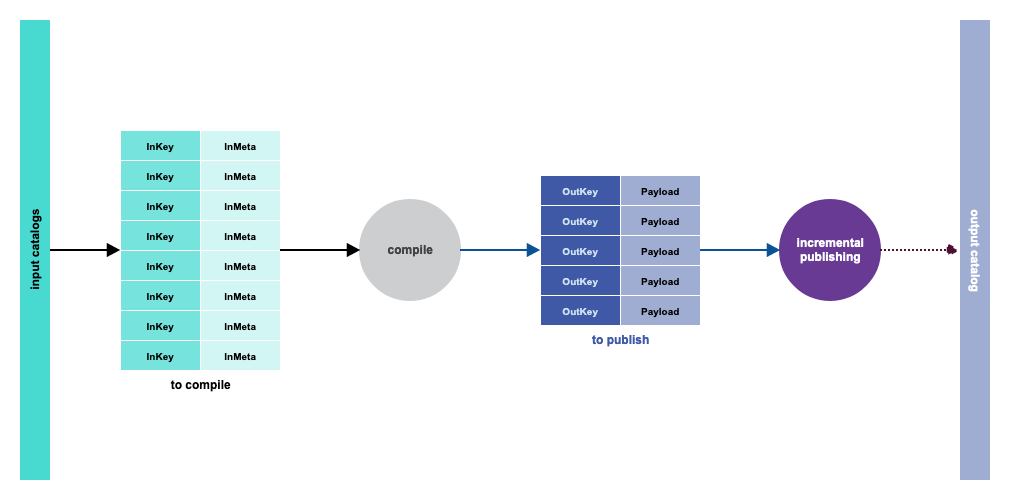
This is the most general compilation pattern, and has no specific applicability
restrictions.
Typical use cases
All cases where the developer wants to freely implement a compiler in terms of
Spark transformations.
High-level interface
There is no front-end and back-end distinction. The only function to be
implemented is:
- compile(toCompile: RDD[(InKey, InMeta)]) ⇒ RDD[(OutKey, Option[Payload])]
Runtime characteristics
The compiler is stateless. State is not present as no incremental compilation
is supported in this pattern, by design.
References
TaskBuilder:withNonIncrementalCompilermethodNonIncrementalCompiler: main interface to implement
DepCompiler and IncrementalDepCompiler
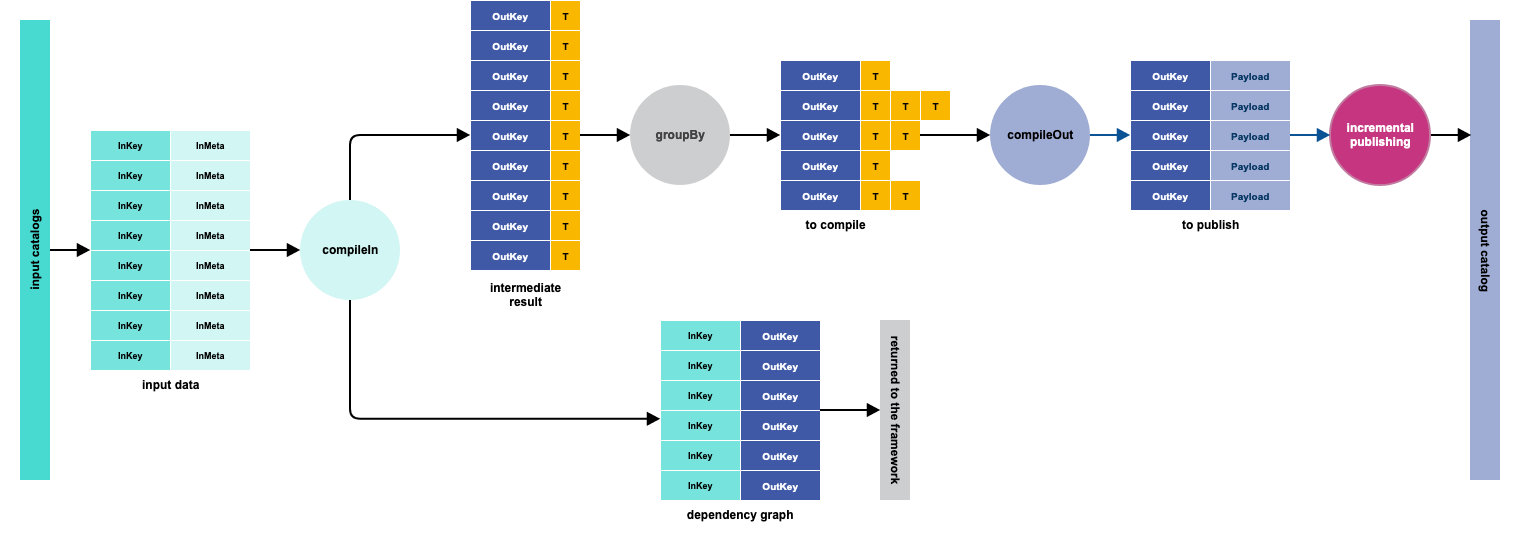
These compilation patterns implement a map-reduce compilation, where the reduce
function does not actually reduce anything, but simply groups the elements with
the same key. This pattern is equivalent to the MapGroup functional compiler.
These two patterns are equivalent. IncrementalDepCompiler is a specialization
of DepCompiler and adds additional logic for a more efficient incremental
compilation.
This compilation pattern can be used for all cases of MapGroupCompiler.
DepCompiler logic
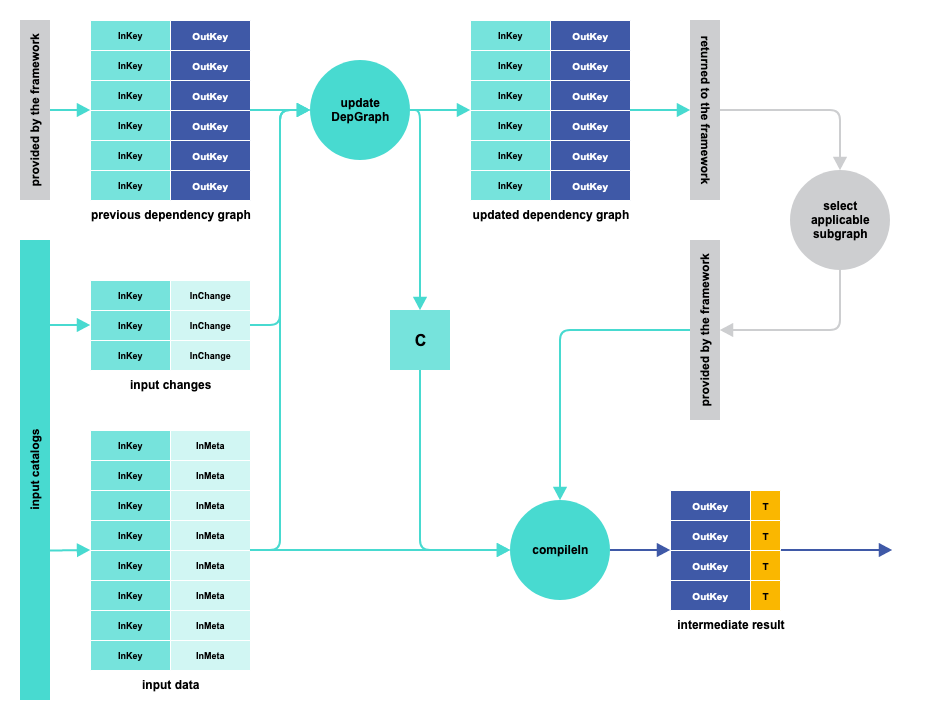
Additional logic introduced with IncrementalDepCompiler
Typical use cases
Use this pattern in cases where the transformation takes into account the input
content, such as:
- Decoding input partitions and distributing content among different output partitions or
as a function of the content. - Creating output layers with a subset of input data.
- Distributing objects from input layers to output layers, shifting levels up
or down, or as a function of object properties. - Indexing of content, for example by country or by tile.
High-level interface
T and C are developer-defined types. The dependency graph or its subsets
have the form of RDD[(InKey, OutKey)].
CompileIn (non-incremental compiler front-end):
- compileIn(inData: RDD[(InKey, InMeta)]) ⇒ dependency graph and RDD[(OutKey,
T)]
CompileIn (additions to run the front-end incrementally):
- updateDepGraph(inData: RDD[(InKey, InMeta)], inChanges: RDD[(InKey,
InChange)], previous dependency graph) ⇒ updated dependency graph and C for
next call
*compileIn(inData: RDD[(InKey, InMeta)], subset of the dependency graph, C
from previous call) ⇒ RDD[(OutKey, T)]
CompileOut (compiler back-end):
- compileOut(toCompile: RDD[(OutKey, Iterable[T])]) ⇒ RDD[(OutKey, Option[
Payload])]
Runtime characteristics
Both versions are stateful.
In DepCompiler, compileIn always runs on the whole set of input catalogs,
also in incremental mode. compileOut is run incrementally, on the subset of
output partitions that the library detects as a candidate for recompilation.
In IncrementalDepCompiler, compileIn (1st version) runs on the
whole set of input catalogs for the non-incremental case. In the incremental
case, updateDepGraph and compileIn (2nd version) run instead.
Access is provided to both the overall data and the changes. compileOut, as
in the previous case, runs only on a subset of output partitions.
References
TaskBuilder:withDepCompilerandwithIncrementalDepCompilermethodsDepCompiler: main interface to implement (non-incremental front-end,
incremental back-end)IncrementalDepCompiler: main interface to implement (incremental front-end
and back-end
Updated 4 months ago