
Transit, V2
The transit layer provides information about public transportation systems, such as buses, trains, subways, and other modes of public transit. The features of this layer enable developers to integrate public transit data into applications or services, allowing users to plan routes, view schedules, and obtain real-time information about public transportation options.
You can request the transit layer by adding the following parameter to your query: content=default,transit. For more information, see Optional content.
Note
The order of attributes in the
contentparameter is important. Specifically, ensure that you position thedefaultattribute as the first one.
The following figure illustrates sample features of the transit layer rendered from the data:
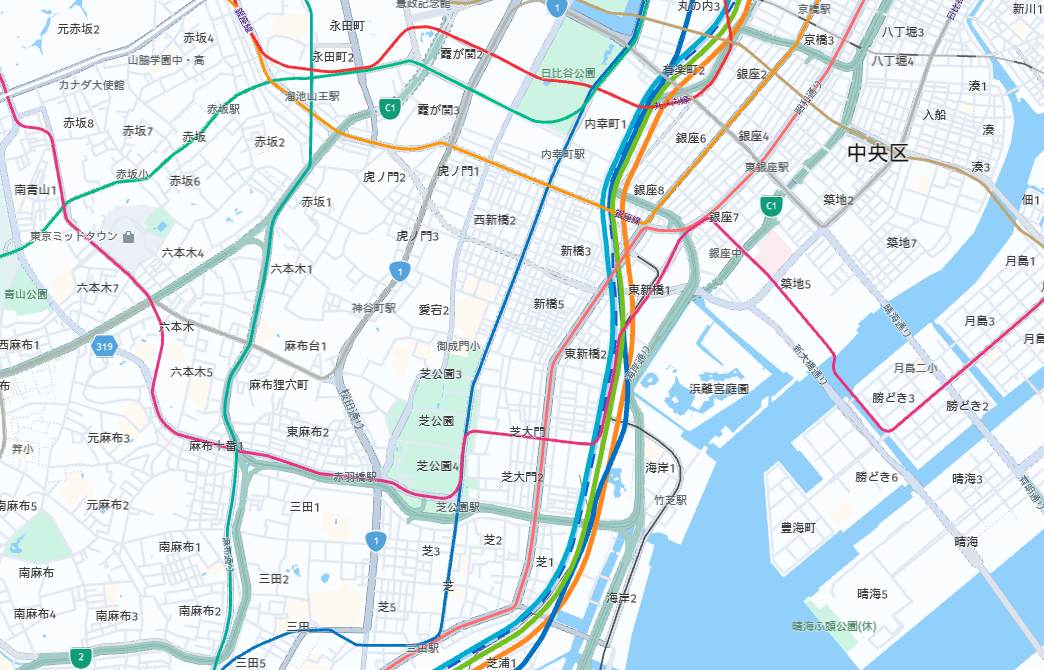 The layer content has the following definition:
- Layer name:
transit - Geometry types:
polygon,line
Transit line features become visible from zoom level 6 onwards, while platform polygons are added at zoom level 14 and higher.
To optimize efficiency, there are 2 levels of features consolidation (LOC):
- LOC 1: There is one line geometry feature for each pair of
kindandkind_detailvalues. It is containing all line names of thiskindandkind_detailon this segment concatenated into one string. This LOD can be used to display a less detailed network (one line perkind_detail) and to display all concatenated labels for thiskind_detail. These concatenated labels could be even used to display all labels well formatted as a row for LOC2 lines. - LOC 2: There is one additional line geometry feature for each PT line segment which has the same
kind,kind_detail,colour. In case several PT lines with the same operator supplied colour/type on the same segment, they geometry is merged into one line and all line names are added as list. Client can do simple parallel line rendering by multiplying the logical offset with the pixel offset defined in the style.
Properties
Every feature in the transit layer includes a set of properties that define it, regardless of the specific transit type it represents.
Consider the following sample parameters for a transit features representing common transit route segment line geometry.
The Tohoku Line intercity line is represented by the color #00BB85, while the Takasaki Line and Utsunomiya Line intercity lines are represented by the color #FF871C:
LOC 1:
...
"kind": "train",
"kind_detail": "intercity",
"min_zoom": 8,
"sort_rank": 436,
"name": "宇都宮線  ·  東北本線  ·  高崎線",
"name:en": "Takasaki Line  ·  Tohoku Line  ·  Utsunomiya Line",
"name:ja": "宇都宮線  ·  東北本線  ·  高崎線",
"name:ko": "다카사키 선  ·  도호쿠 본선  ·  우쓰노미야 선",
"name:zh": "宇都宮線  ·  東北本線  ·  高崎線",
...
In the context of this example, consider the following transit feature properties:
kind- The general type of transit feature.kind_detail- This property provides additional details about thekindof transit feature. This parameter is relevant only within the context of thelinegeometry type.min_zoom- The recommended minimum zoom level at which thetransitfeature should be displayed.sort_rank- A value used to prioritize the display order of different types of transit features on the map. A transit feature with a highersort_rankvalue is displayed on top of a transit feature with a lowersort_rankvalue.name- A dot-separated sorted list of all the route names valid on this transit line segment. In the example, the line has 3 intercity routes:宇都宮線,東北本線, and高崎線. This parameter is relevant only within the context of thelinegeometry type.name:*- Localized dot-separated sorted list of the route names. For example, in English, the routes from the example are referred to asTakasaki Line,Tohoku Line, andUtsunomiya Line. The same routes are also provided in other languages as identified by ISO 639-1 two-letter language codes.
LOC 2:
...
"source": "ipc",
"kind": "train",
"kind_detail": "intercity",
"num_lines": 2,
"min_zoom": 8,
"logical_offset": 0,
"sort_rank": 436,
"ref": ";東北本線;",
"name": "東北本線",
"name:en": "Tohoku Line",
"name:ja": "東北本線",
"name:ko": "도호쿠 본선",
"name:zh": "東北本線",
"colour": "#00BB85",
"direction": "F",
"operator": "101037_a7e604b",
......
"source": "ipc",
"kind": "train",
"kind_detail": "intercity",
"num_lines": 2,
"min_zoom": 8,
"logical_offset": 1,
"sort_rank": 436,
"ref": ";高崎線;宇都宮線;",
"name": "宇都宮線 · 高崎線",
"name:en": "Takasaki Line · Utsunomiya Line",
"name:ja": "宇都宮線 · 高崎線",
"name:ko": "다카사키 선 · 우쓰노미야 선",
"name:zh": "宇都宮線 · 高崎線",
"colour": "#FF871C",
"direction": "F;F",
"operator": "101037_a7e604b;101037_a7e604b",
...In the context of this example, consider the following transit feature properties:
kind- The general type of transit feature.kind_detail- This property provides additional details about thekindof transit feature. This parameter is relevant only within the context of thelinegeometry type.min_zoom- The recommended minimum zoom level at which thetransitfeature should be displayed.sort_rank- A value used to prioritize the display order of different types of transit features on the map. A transit feature with a highersort_rankvalue is displayed on top of a transit feature with a lowersort_rankvalue.name- A dot-separated list of the route names valid on this transit line segment wit samecolour. In the example, the first intercity line feature: has 1 intercity routes:東北本線, and second feature has 2 routes:宇都宮線and高崎線. This parameter is relevant only within the context of thelinegeometry type. It has alphabetical order.name:*- Localized dot-separated ordered list of the route names. For example, in English, the routes from the example are referred to asTohoku Linefor first feature, andTakasaki Line,Utsunomiya Linefor second one. The same routes are also provided in other languages as identified by ISO 639-1 two-letter language codes.colour- A hex values representing the color for the routes valid on this line. In the example, there are 3 intercity routes on transit segment with 2 different colors. There is separate feature for each color. The first intercity line feature with color#00BB85corresponds to the東北本線(Tohoku Line) route, and the second feature with color#FF871Ccorresponds to the宇都宮線,高崎線(Takasaki Line,Utsunomiya Line) routes.ref- A semicolon-separated list of route names valid on this transit line segment wit samecolourin order according to source. This parameter is relevant only within the context of thelinegeometry type.direction- The parameterdirectionspecifies all the directions of the routes that are valid on a line segment for particular line color. The values are provided as semicolon-separated values. The following conventions are used:Frepresents the forward direction of the route.Brepresents the backward direction of the route.- An empty value indicates that the route has both directions.
The direction values correspond to the values of the ref parameter, and they are matched in the given order.
For example, if direction is set to ";F", it means that the first route is valid in both directions, while the second route is valid only in the forward direction.
This parameter is relevant only within the context of the line geometry type.
text_colour- Colors used for drawing the text of reference values for the routes valid on this line. It follows the same format ascolour. This parameter is relevant only within the context of thelinegeometry type.operator- A semicolon-separated list of operator IDs for the routes valid on this line segment for particular color. For example,"operator": "101037_a7e604b;101037_a7e604b". The first operator ID corresponds to the operator of the高崎線(Takasaki Line) route, and the second operator ID corresponds to the operator of the宇都宮線(Utsunomiya Line) route.logical_offset- is a line offset calculated across all lines in segment with samekindandkind_detailin range from0tillnum_lines. In the example, the first intercity line feature has"logical_offset": 0, and second feature has"logical_offset": 1. This parameter is relevant only within the context of thelinegeometry type.num_lines- count of line features in segment with samekindandkind_detail. In the example, there are 2 line features with different color on the segment; thus, each feature has the attribute:"num_lines": 2.
kind and sort_rank values for the transit layer
kind and sort_rank values for the transit layerThe following list provides kind values for transit layer features and their corresponding sort_rank values.
For more information about the map parameters available in the HERE Vector Tile API, see Map Parameter.
railway_station_platform- (sort_rank: 385) - Platform of a railway station.subway_station_platform- (sort_rank: 385) - Platform of a subway station.funicular(sort_rank: 430) - A transportation system that uses cable-operated cars on steep inclines.monorail(sort_rank: 431) - A railway system where the trains run on a single rail.subway(sort_rank: 432) - An underground or elevated railway system typically found in urban areas.light_rail(sort_rank: 429, 433) - A type of urban rail transit that operates with light capacity and shares tracks with other vehicles. The actualsort_rankvalue depends on the specific kind_detail for this feature instance.train(sort_rank: 382, 435, 436, 437, 445, 446) - A general term referring to a mode of transportation that runs on tracks, typically used for intercity or regional travel. The actualsort_rankvalue depends on the specific kind_detail for this feature instance.aerial(sort_rank: 442) - A transportation system that operates above ground level, such as an aerial tramway or gondola.ferry(sort_rank: 411) - A transportation system that operates short- and long-distance boat services.air(sort_rank: 443) - A transportation system that operates in air, such as an airlines.
kind_detail and sort_rank values for the transit layer
kind_detail and sort_rank values for the transit layerThese kind_detail values provide additional information about the transit feature type.
For more information about the map parameters available in the HERE Vector Tile API, see Map Parameter.
tram(sort_rank: 429) - Represents tram lines for thelight_railkind.suburban(sort_rank: 433) - Indicates suburban rail lines for thelight_railkind.funicular(sort_rank: 430) - Indicates funicular lines for thefunicularkind.monorail(sort_rank: 431) - Denotes monorail lines for themonorailkind.subway(sort_rank: 432) - Represents subway lines for thesubwaykind.train(sort_rank: 382) - Indicates other railroad lines with thetrainkind.regional(sort_rank: 435) - Denotes regional railroad lines with thetrainkind.intercity(sort_rank: 436) - Represents intercity railroad lines with thetrainkind.high_speed(sort_rank: 437) - Indicates high-speed railroad lines with thetrainkind.touristic(sort_rank: 444) - Indicates touristic railroad lines with thetrainkind.tram_touristic(sort_rank: 445) - Indicates touristic tram lines with thetrainkind.airport_terminal(sort_rank: 446) - Indicates airport terminal lines with thetrainkind.aerial(sort_rank: 442) - Denotes aerial cable car or gondola lines for theaerialkind.ferry(sort_rank: 411) - Denotes short- and long-distance boat lines for theferrykind.air(sort_rank: 443) - Denotes airline lines for theairkind.
Next steps
- For more information about other layer feature types available in the HERE Vector Tile API, see Tile Layers.
Updated last month